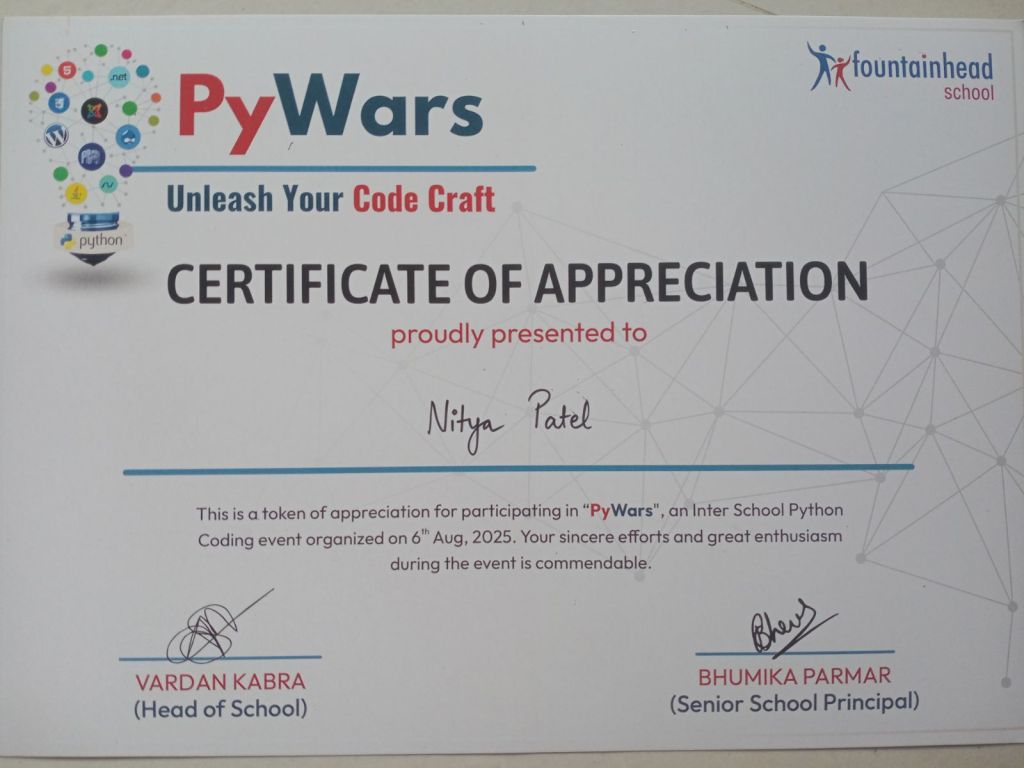
Participating in PyWars, an interschool Python programming competition, was an exciting opportunity to challenge my coding skills and apply computational thinking in a competitive environment. Although our team did not win, the experience itself was incredibly valuable, as it pushed me to think critically, collaborate effectively, and learn from other talented participants.
LO 1 — Identify Own Strengths and Develop Areas for Growth
During the competition, I realized that I have strong analytical and logical thinking skills, which helped in understanding programming problems and attempting efficient solutions. However, I also discovered areas for improvement, particularly in time management during coding challenges and debugging under pressure.
This experience highlighted the importance of practicing algorithmic thinking and strengthening my Python programming knowledge.
LO 2 — Demonstrate That Challenges Have Been Undertaken
The competition presented complex coding problems that required quick thinking and problem-solving. Some tasks were significantly more difficult than expected, and working under strict time limits added to the challenge.
Even though our team faced difficulties solving certain problems, we remained engaged and continued attempting solutions, which taught me resilience and persistence.
LO 3 — Demonstrate How to Initiate and Plan a CAS Experience
Before participating in the competition, our team prepared by practicing Python problems and discussing possible strategies for tackling coding challenges. Planning our approach helped us divide tasks effectively and collaborate during the event.
This preparation demonstrated how planning and practice play a key role in performing well in competitive environments.
LO 4 — Show Commitment and Perseverance in CAS Experiences
Despite not winning the competition, we remained committed throughout the event and continued working on the problems until the end. This perseverance helped me understand that growth often comes from challenging experiences rather than only successful outcomes.
LO 5 — Demonstrate the Skills and Recognize the Benefits of Working Collaboratively
The competition required strong teamwork. My teammates and I discussed possible solutions, reviewed each other’s code, and supported one another when encountering errors.
Working collaboratively allowed us to combine our strengths and approach problems from multiple perspectives.
LO 6 — Demonstrate Engagement with Issues of Global Significance
Programming and computational thinking are essential skills in today’s digital world. By participating in PyWars, I engaged with the broader global emphasis on technological literacy and innovation, which aligns with SDG 4: Quality Education by promoting skills relevant to future careers in science and technology.
LO 7 — Recognize and Consider the Ethics of Choices and Actions
During the competition, it was important to maintain academic integrity, ensuring that all code and solutions were developed independently by our team. Respecting competition rules reinforced the value of fairness and ethical conduct in academic and professional settings.
Final Reflection — Growth Through Challenge
Although we did not win PyWars, the experience was far from a failure. Instead, it became a learning opportunity that strengthened my programming skills, teamwork abilities, and resilience.
This CAS experience helped me develop:
- Logical and computational thinking
- Problem-solving under pressure
- Teamwork and collaboration
- Perseverance in challenging situations
Most importantly, it reminded me that true learning often happens when we face challenges and continue trying despite setbacks.