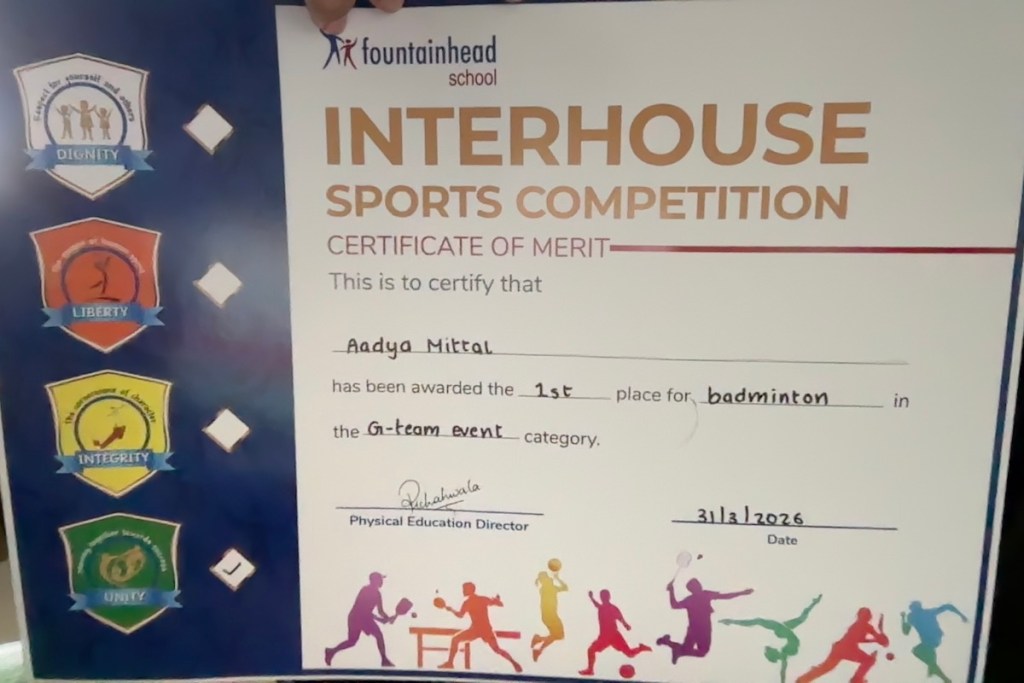
Badminton is a sport that not only demands physical agility and precision but also requires strong coordination and communication when played as a team. Unlike individual matches, team-based tournaments emphasize collective performance, where each player’s contribution directly impacts the overall result. This creates a dynamic environment where collaboration, strategy, and mutual support become essential for success.
I participated in an interhouse badminton tournament as part of a team, where we competed against other houses and ultimately secured first position. The experience was both challenging and rewarding, as it required me to not only focus on my individual performance but also contribute effectively to the team’s overall success. Competing in a team format introduced a new dimension to the sport, where communication, encouragement, and shared responsibility played a significant role. Throughout the tournament, I developed a deeper understanding of teamwork, perseverance, and self-reflection, while also enhancing my skills in a competitive setting.
LO1: Identify own strengths and develop areas for growth
Through this experience, I was able to reflect on my strengths as well as identify areas where I could improve. One of my key strengths was my ability to remain composed under pressure, especially during crucial points in matches. I was able to maintain focus and execute shots effectively, which contributed positively to the team’s performance. Additionally, my quick reflexes and ability to anticipate my opponent’s moves helped me gain an advantage during rallies.
However, participating in a team event also made me more aware of areas that required improvement. I realized that while my individual gameplay was strong, I needed to improve my coordination and communication with my partner during doubles matches. At times, there was confusion regarding positioning and shot selection, which affected our efficiency. This reflection helped me understand the importance of developing not just individual skills but also team-based coordination. As a result, I became more conscious of working on communication and strategic alignment with my teammates in future matches.
LO2: Demonstrate that challenges have been undertaken, developing new skills
The interhouse tournament presented several challenges that pushed me beyond my comfort zone. Competing as part of a team added pressure, as my performance directly influenced the overall outcome. This responsibility required me to stay mentally strong and adapt to different situations during matches.
One of the main challenges was adjusting to different opponents, each with their own playing style and strategies. This required me to think quickly and modify my approach during gameplay. Additionally, playing doubles matches required me to develop new skills such as better court coverage, coordination with my partner, and strategic communication. Over time, I improved my ability to anticipate my partner’s movements and make quick decisions, which enhanced our performance as a team. These challenges ultimately helped me grow as a player and strengthened my ability to adapt in competitive situations.
LO4: Show perseverance and commitment in CAS experiences
Preparing for and participating in the tournament required consistent effort and dedication. Balancing practice sessions with academic responsibilities was challenging, but I remained committed to improving my performance. Regular practice helped me refine my techniques and build confidence in my abilities.
During the tournament, there were moments when matches became intense and physically demanding. In some situations, we faced strong opponents and had to work harder to maintain our lead. Instead of becoming discouraged, I remained focused and continued to give my best effort in every point. The determination to contribute to the team’s success motivated me to push through fatigue and maintain a positive mindset. Securing first position as a team was a reflection of our collective perseverance and commitment, and it reinforced the importance of staying dedicated even in challenging situations.
LO5: Demonstrate skills and recognize the benefits of working collaboratively
One of the most significant aspects of this experience was the emphasis on teamwork and collaboration. Unlike individual matches, the team format required constant communication and coordination with my teammates. Supporting each other, sharing strategies, and maintaining a positive attitude were essential for achieving success.
Working collaboratively allowed us to combine our strengths and compensate for each other’s weaknesses. For example, during doubles matches, effective communication helped us avoid confusion and improve our coordination on the court. Additionally, encouraging each other during matches created a supportive environment that boosted our confidence and morale. This experience helped me realize that collaboration is a powerful tool in achieving shared goals. It also taught me that success is not just about individual performance but about how well a team works together to overcome challenges.