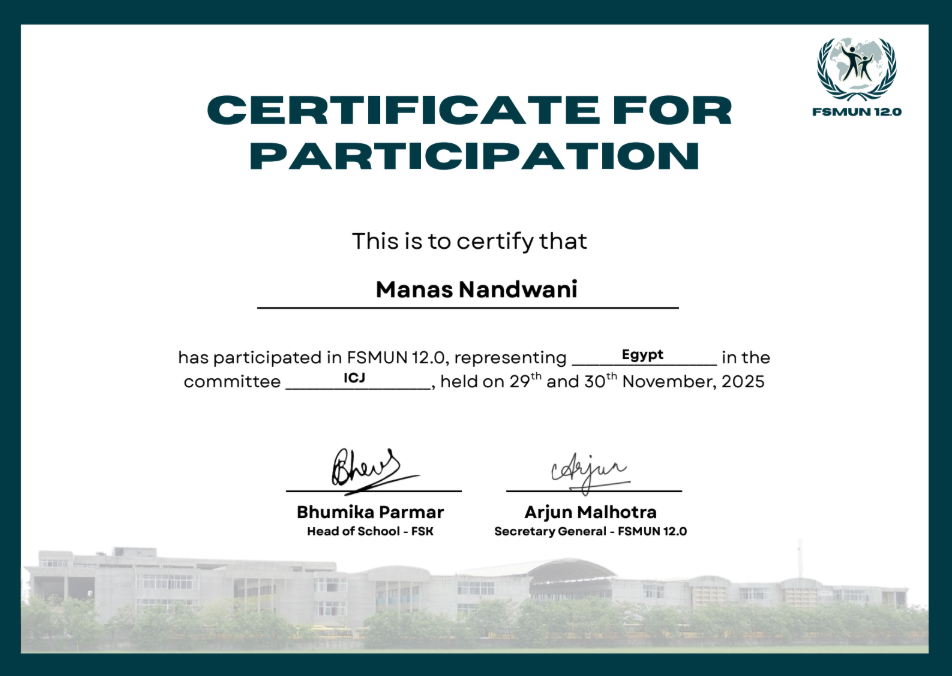
Stepping into FS MUN 12, I knew I was in for a challenge, but walking into the International Court of Justice (ICJ) as the Delegate/Judge of Egypt was an entirely different ball game. Unlike traditional Model UN committees where the goal is to politically debate and pass resolutions, the ICJ demanded that we strip away the political rhetoric and look at global crises strictly through the lens of international law.
Facing the Legal Challenge (LO 2: Challenge & Skills)
My preparation started weeks before the conference. I had to deep-dive into dense treaty texts, state sovereignty laws, and past precedents set by the real world’s highest court. Acting as a judge representing Egypt pushed me entirely out of my comfort zone. I couldn’t just argue based on what sounded good; every point I made had to be backed by legal clauses and historical evidence. Mastering the specific parliamentary procedures of a court—like cross-examining advocates and evaluating testimonies—was a massive learning curve, but it significantly sharpened my critical thinking and analytical skills.
Deliberating in the Chambers (LO 5: Collaborative Skills)
Once the advocates presented their cases, the real work began behind closed doors during judicial deliberations. This is where the importance of collaboration became real. A room full of judges all had different interpretations of the law. I had to work closely with my peers to cross-examine arguments, weigh the validity of evidence, and find common ground. Writing the final judgment required intense negotiation and teamwork, as we had to co-author a unified, legally airtight majority opinion that accurately reflected our collective verdict.
A Global Perspective (LO 6: Global Engagement)
Evaluating a complex international dispute forced me to engage deeply with real-world issues that impact global security and human rights. It made me realize how fragile, yet incredibly vital, international legal frameworks are in maintaining global peace (SDG 16: Peace, Justice, and Strong Institutions). Looking at international conflicts not as a politician, but as a principled judge, completely changed my perspective on how global crises are resolved.
Final Reflection
Representing Egypt in the ICJ was one of the most intellectually demanding experiences of my academic journey so far. It taught me how to think like a lawyer, collaborate under pressure, and speak with precision. I’m walking away from FS MUN 12 with a much deeper appreciation for international law and far more confidence in my own analytical and public speaking abilities.