Creativity CAS Experience
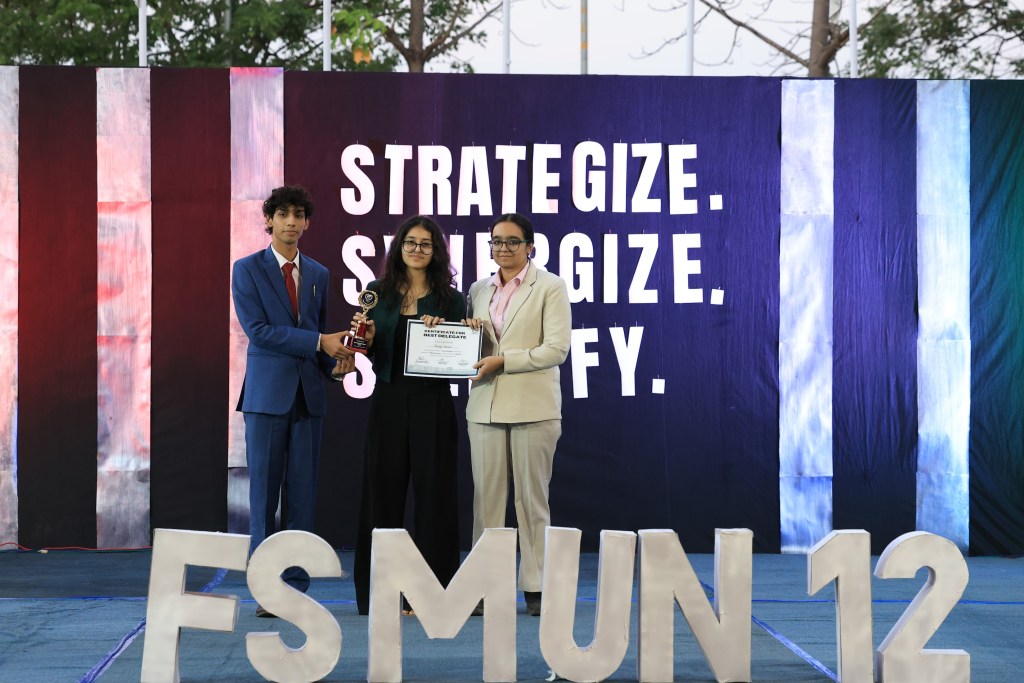
Participating in FSMUN 12.0 as a delegate in the United Nations Human Rights Council (UNHRC) was one of the most intellectually demanding CAS experiences in my portfolio. Representing the Democratic People’s Republic of Korea, a country frequently criticised for its human rights record, required me to engage with uncomfortable perspectives while maintaining diplomatic integrity. This experience went beyond public speaking or debate; it demanded ethical awareness, perseverance, and a deep engagement with issues of global significance.
LO1: Identifying strengths and areas for growth
This experience allowed me to clearly identify my strengths in research, critical analysis, and structured communication. Preparing for committee sessions involved analysing UN reports, state policies, and diplomatic rhetoric, which I was able to synthesise into coherent and persuasive arguments. At the same time, representing a position I personally disagreed with revealed areas for growth, particularly in emotional detachment and adaptability. I had to learn how to argue from a state’s perspective rather than a personal one, which strengthened my ability to approach issues objectively and professionally.
LO2: Undertaking challenges and developing new skills
Representing North Korea in the UNHRC was inherently challenging, as it required defending positions under constant scrutiny from other delegates. I had to develop new skills such as strategic framing, where arguments were constructed around sovereignty, non-interference, and cultural relativism rather than moral justification. I also learned how to negotiate under pressure, respond to criticism diplomatically, and adapt my stance in real time during moderated and unmoderated caucuses. These skills were developed through direct engagement and could not have been learned through theory alone.
LO4: Perseverance and commitment
The preparation for FSMUN 12.0 required sustained commitment, including extensive research before the conference and active participation throughout all committee sessions. Despite facing strong opposition and difficult questioning, I remained engaged and consistent in my contributions to debate and resolution drafting. This perseverance allowed me to maintain credibility in committee and reflect a high level of dedication to the CAS experience, reinforcing the importance of resilience and follow-through.
LO6: Engagement with issues of global significance
Human rights, state accountability, and international governance are globally significant issues that directly affect millions of people. Through the UNHRC committee, I engaged deeply with debates surrounding freedom, state sovereignty, and international intervention. This experience helped me understand why achieving consensus on human rights is complex and often politically constrained. It strengthened my awareness of global power dynamics and reinforced my interest in international law and human rights advocacy.
LO7: Ethical consideration of choices and actions
This experience required constant ethical reflection. Representing a state accused of human rights violations forced me to consider the moral implications of my arguments and the responsibility that comes with representation. I learned to differentiate between understanding a perspective and endorsing it, ensuring that my participation remained respectful and informed. This ethical awareness will influence how I approach future leadership roles, especially in spaces that require balancing principle with pragmatism.
Conclusion
FSMUN 12.0 was not just a simulation but a meaningful CAS experience that contributed significantly to my personal and intellectual growth. It challenged my assumptions, expanded my skill set, and deepened my understanding of global issues. This experience stands as a strong reflection of my CAS journey and has shaped the way I engage with complex ethical and international challenges moving forward.