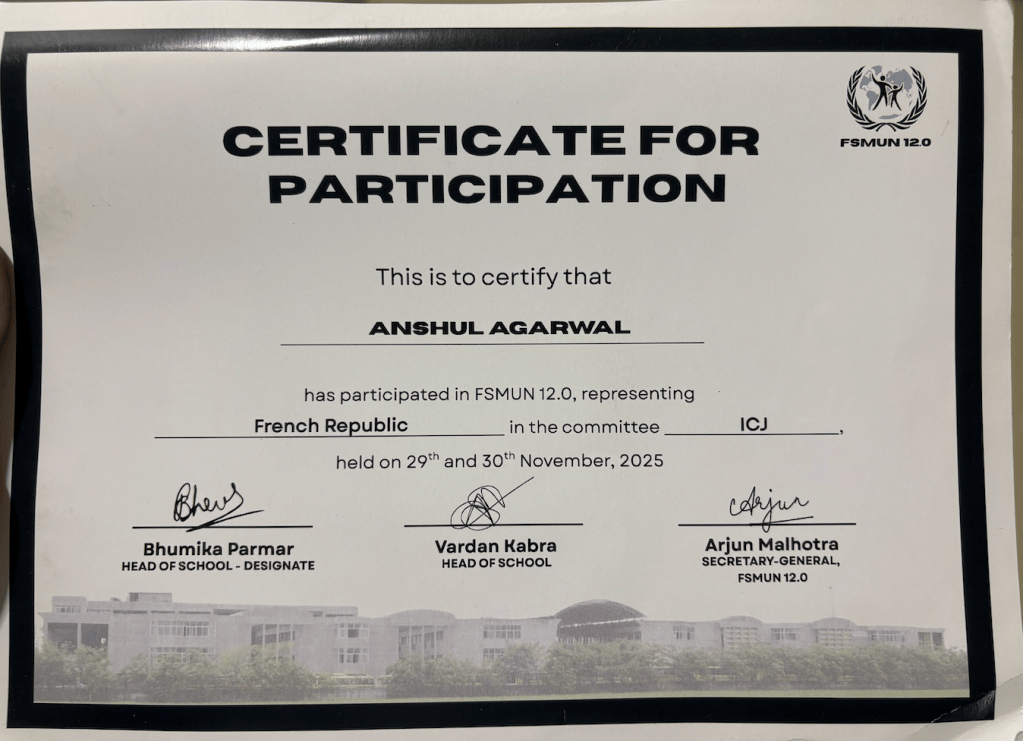
On November 29th and 30th, I stepped into the role of a Judge/Delegate representing France in the International Court of Justice (ICJ) at Fountainhead School Model United Nations (FSMUN 12.0). Unlike typical MUN committees, the ICJ demanded a deep dive into international law, treaty interpretations, and judicial proceedings. Over the course of two days, I navigated complex legal arguments and simulated a high-stakes courtroom environment to address global disputes.
LO1 – Identify own strengths and develop areas for growth
Through this experience, I identified that my strength lies in logical reasoning and evidence-based analysis. However, I recognized an “area for growth” in spontaneous public speaking, specifically during the cross-examination of witnesses. I had to learn how to think on my feet and formulate pointed, legal questions under pressure, which significantly improved my confidence in impromptu oratory by the end of the conference.
LO2 – Demonstrate that challenges have been undertaken, developing new skills
The ICJ is widely considered one of the most intellectually challenging committees. Undertaking this role required me to develop the skill of writing “memorials” (legal documents) and understanding the “Statute of the ICJ.” Learning how to balance France’s national interests with the impartial role of a judge was a steep learning curve that forced me to develop a more sophisticated understanding of international jurisprudence.
LO3 – Initiate and plan a CAS experience
Success in the ICJ started weeks before the conference. I had to initiate a rigorous research plan, studying French foreign policy, past ICJ rulings, and the specific details of the case at hand. This careful preparation and planning were essential to ensure that I could contribute meaningfully to the deliberations and draft clauses that were legally sound and historically accurate.
LO5 – Demonstrate skills and benefits of working collaboratively
Even in a courtroom setting, collaboration is vital. I worked closely with fellow judges to weigh the evidence presented by the advocates. The benefits of working collaboratively were most clear during the final deliberations, where our collective discussion helped clarify complex legal points that an individual might have overlooked. This teamwork was crucial in reaching a well-reasoned and balanced “verdict.”
LO6 – Engagement with issues of global significance
My participation in FSMUN 12.0 was a direct engagement with the global issue of peace and international justice. By simulating the resolution of territorial and legal disputes, I addressed the UN Sustainable Development Goal of “Peace, Justice and Strong Institutions.” This experience highlighted the importance of using legal frameworks rather than conflict to resolve the world’s most pressing issues.
LO7 – Recognise and consider the ethics of choices and actions
Being a part of the ICJ required me to constantly consider the ethics of my judicial choices. I had to ensure that my arguments were not just politically convenient for France, but ethically consistent with international law. This forced me to evaluate the “ethics of action”—recognizing that the decisions made in court have real-world consequences for sovereignty, human rights, and global stability.
Conclusion
FSMUN 12.0 was a challenging and transformative experience. Even though I did not win an award, the process of defending a position in the International Court of Justice gave me a profound respect for the complexities of global law. I am walking away with sharper critical thinking skills, a more principled approach to debate, and a deeper interest in the structures that maintain global order.