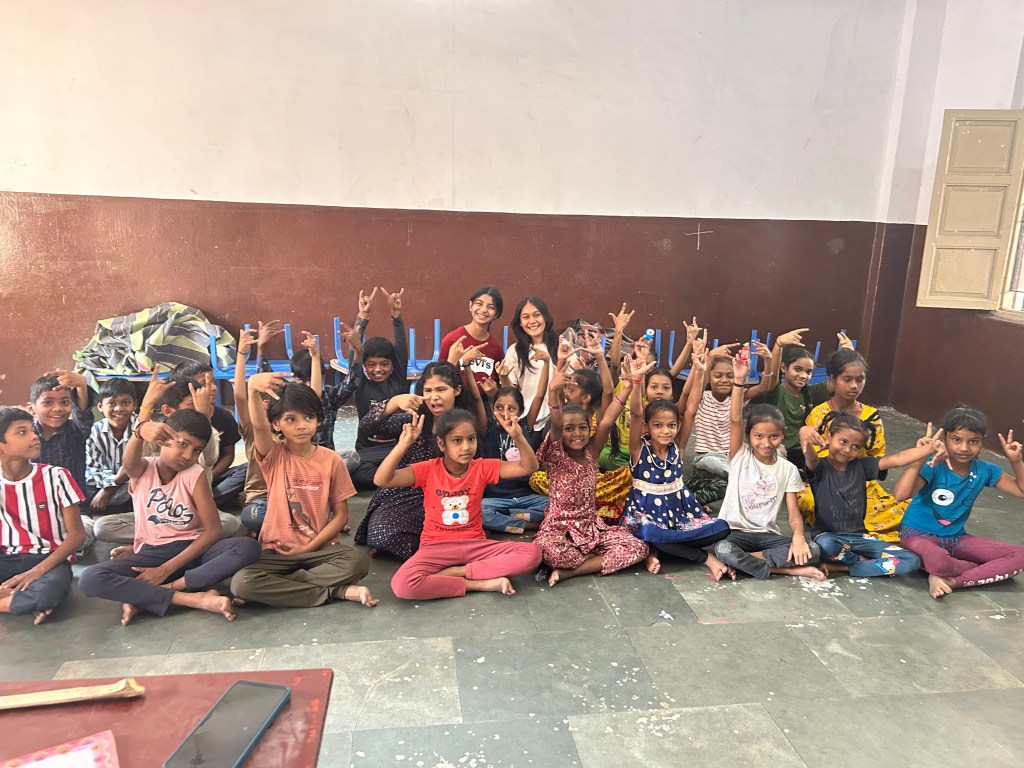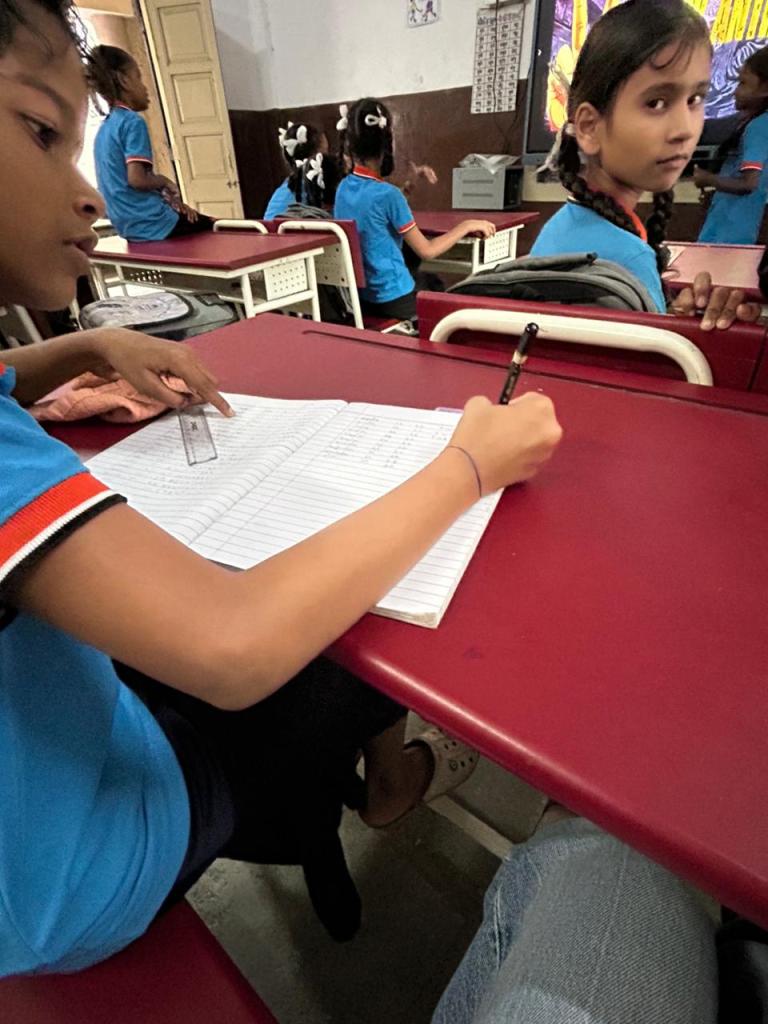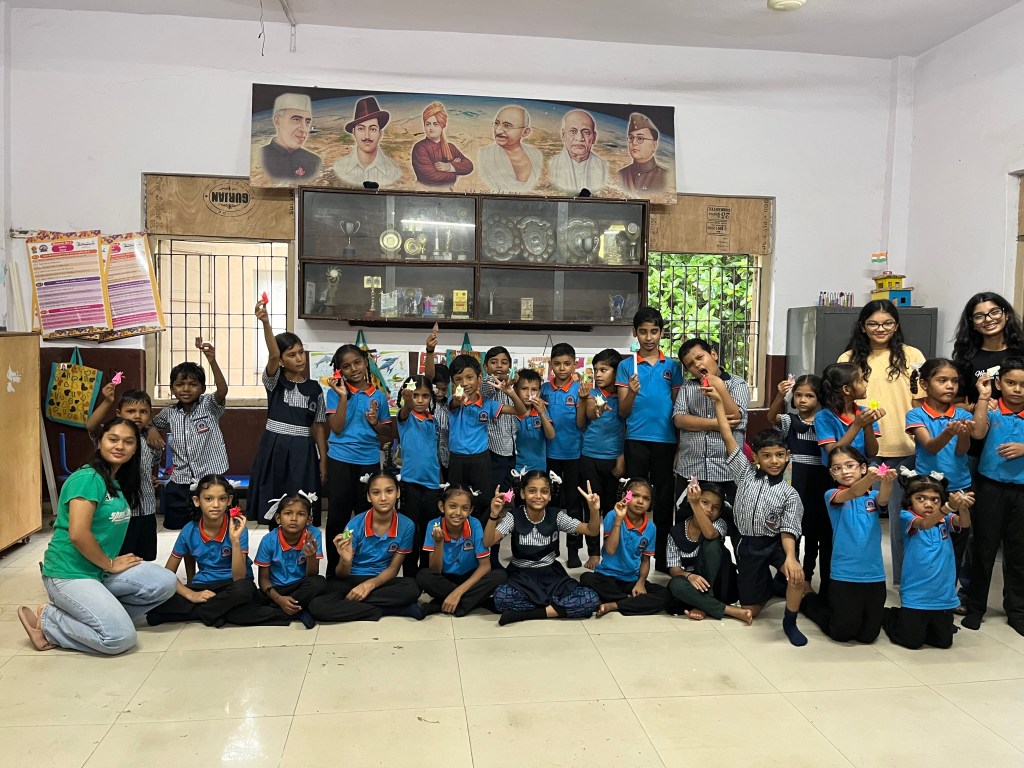
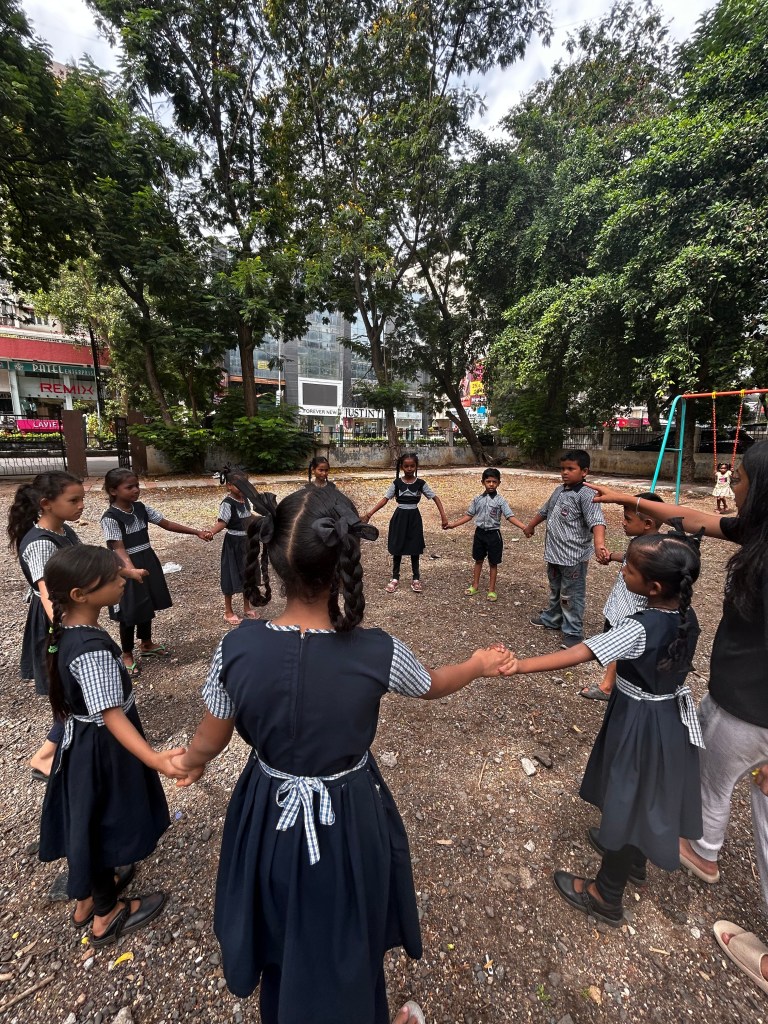
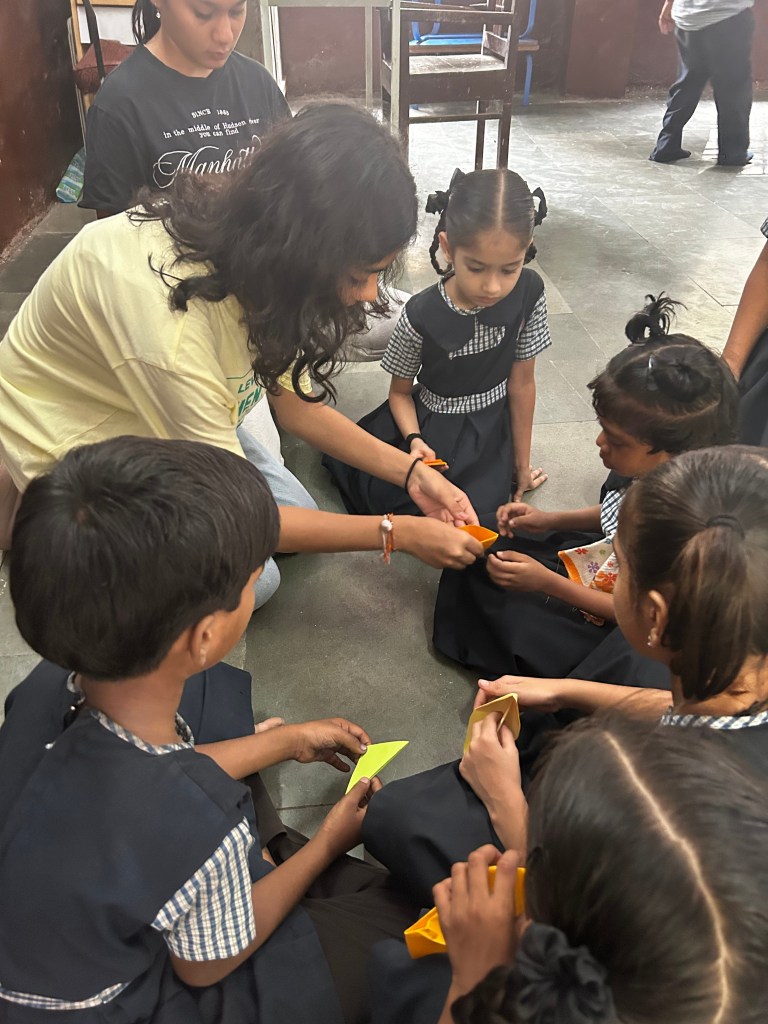
For my CAS Enrichment experience, I worked with students from financially disadvantaged backgrounds who lacked access to tuition and structured academic support. My goal was to help them understand their school subjects better and make learning more engaging and accessible. I supported them by explaining concepts, solving doubts, and guiding them through their daily schoolwork. Since most students were comfortable only in Gujarati, I primarily communicated in Gujarati while teaching English, Gujarati, and Mathematics. I also used games and interactive activities to make learning less intimidating. Through this experience, I aimed to support their academic growth while fostering confidence and motivation.
Learning Outcome 1: Identify Own strengths & Develop Areas for Growth
This experience helped me identify communication as one of my strengths, especially my ability to explain concepts clearly in Gujarati and adapt my teaching style to the students’ needs. At the same time, I became aware of my weakness, initially struggling to manage students with very different learning paces. Recognizing this made me more patient and flexible. Knowing both strengths and weaknesses is important because it allows personal growth and self-awareness. I consciously worked on improving my patience and adaptability, which helped me create a more inclusive learning environment and strengthened my confidence as a mentor.
Learning Outcome 2: Demonstrate Challenges That Have Been Undertaken, Developing New Skills
One major challenge was teaching students who had gaps in basic concepts and low academic confidence. This was difficult because traditional teaching methods did not always work. I had not done formal teaching in such an environment before, especially across language barriers. I overcame this by using games, examples from daily life, and visual explanations. Through this, I developed new skills such as simplifying complex ideas, classroom management, and creative teaching. These skills will be useful in the future when working with diverse groups. Undertaking this challenge made me feel more capable and resilient.
Learning Outcome 3: Demonstrate How to Initiate & Plan a CAS Experience
I had to organize my sessions in advance by planning what topics to teach, preparing simple activities, and adjusting lessons based on students’ understanding. While I consider myself moderately organized, initiating the experience required stepping out of my comfort zone. Planning was easier than initiating because it involved taking responsibility for others’ learning. I discovered planning skills such as time management and adaptability. This experience has made future planning easier and taught me the importance of preparation when leading any educational or community-based activity.
Learning Outcome 4: Show Commitment to & Perseverance in CAS Experiences
The activity required consistent commitment, especially when students felt demotivated or struggled to grasp concepts. Perseverance was necessary when progress was slow. Staying committed despite challenges made me feel responsible and emotionally invested in their growth. Persistence is important because meaningful change takes time. This experience taught me that showing up regularly and maintaining consistency can significantly impact others, even when results are not immediately visible.
Learning Outcome 5: Demonstrate the Skills & Recognize the Benefits of Working Collaboratively
Working with students was both challenging and rewarding. While collaboration is generally comfortable for me, this experience required empathy and leadership rather than equal teamwork. Some students were hesitant or shy, which required me to adjust my approach. Leadership played a key role in guiding discussions, encouraging participation, and building trust. Learning to work collaboratively is important because it builds communication, understanding, and shared responsibility.
Learning Outcome 6: Demonstrate Engagement with Issues of Global Significance
This activity addressed the global issue of educational inequality, where financial limitations prevent access to quality education. This is a widespread issue affecting students across many regions, especially in developing communities. Becoming aware of this issue made me more appreciative of my own educational opportunities and more conscious of my social responsibility. Contributing through this CAS experience made me feel empowered, as I was directly involved in addressing an issue that has long-term societal consequences.
Learning Outcome 7: Recognize & Consider the Ethics of Choices & Actions
Ethical considerations included ensuring equal attention to all students and respecting their linguistic and cultural background. These issues affected me directly, as my actions influenced their learning experience. Before this activity, I viewed education mainly as academic achievement; afterward, I recognized it as a right that should be accessible to everyone. This experience reinforced the importance of fairness, respect, and responsibility in community engagement.
Final Takeaway
This CAS experience helped me develop IB learner profile attributes such as caring, communicative, reflective, and principled. It connects strongly with my academic subjects by strengthening my language, analytical, and problem-solving skills. The activity benefited students by improving their confidence, study habits, and understanding of core subjects. The highlight was seeing students actively participate and express excitement toward learning. My perspectives on privilege and education were deeply challenged. This experience brought a strong sense of accomplishment and purpose. If I were to repeat this activity, I would incorporate more structured assessments to track progress. I hope to continue contributing to society by supporting accessible education and mentoring students in the future.
Link to Theory of Knowledge
This CAS experience links strongly to TOK as my choices and actions such as teaching in Gujarati and adapting lessons to students’ needs modeled empathy, compassion, and respect by valuing their backgrounds and learning realities. It allowed me to become a genuine inquirer by constantly questioning how knowledge should be shared, understood, and made accessible rather than assuming one method works for all. The experience encouraged creative and critical thinking as I designed games, simplified concepts, and adjusted strategies based on students’ responses. Ethical issues around fairness and equal access to education guided me to act in a principled manner. Finally, stepping into a teaching role involved intellectual and emotional risk-taking, supported by a safe learning environment that encouraged growth for both the students and myself.