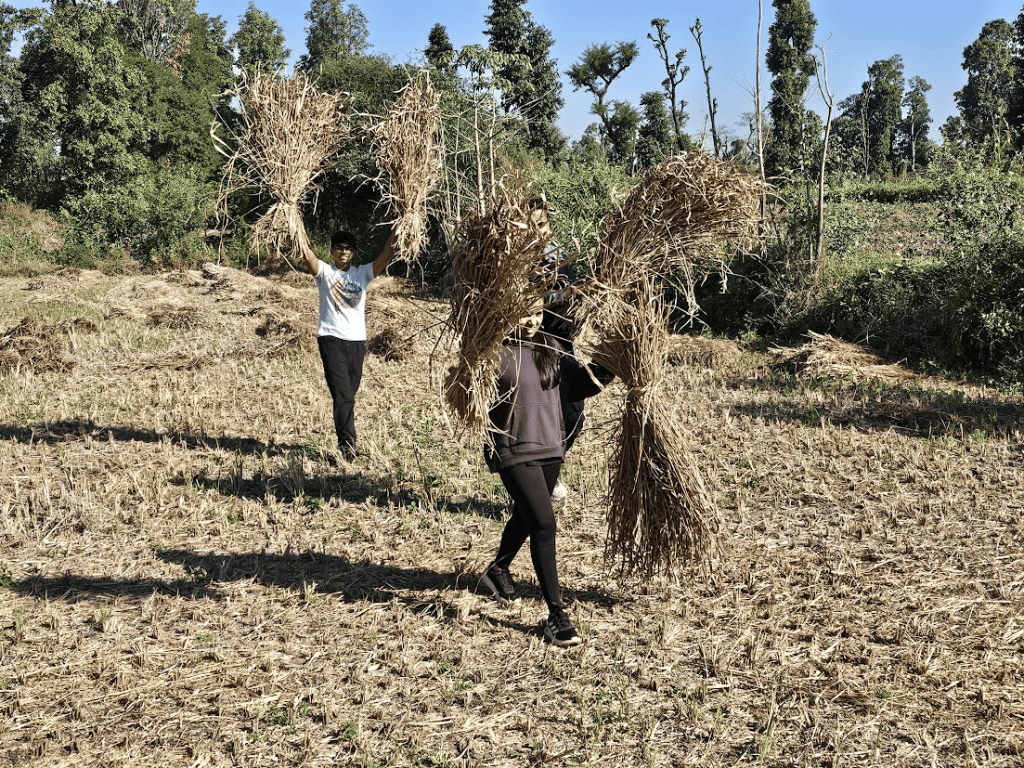
For six days, I lived in Ambapani as part of a rural immersion program, and it turned out to be one of the more unexpected experiences I have had. Farming, making things out of bamboo, learning Warli painting, and spending real time with the people who live there put me in situations I could not have imagined from a classroom. The point of it all was to understand rural life, not just read about it, and to reflect on the differences between the world I come from and the one I was temporarily a part of. By the end of it, I came back thinking differently about a lot of things I had never really questioned before.
LO 1 – Identify own strengths and develop areas for growth
Ambapani had a way of stripping things back. The mornings started early, bathing in the river was just part of the routine, and meals were shared with whoever was around. None of it was what I was used to, and adjusting to that took more out of me than I expected. But I did adjust, and that told me something about myself I had not fully recognised before. At the same time, I noticed I struggled when things moved slowly or changed without warning. That kind of impatience is something I had not paid much attention to before, and seeing it clearly made me want to work on it.
LO 2 – Demonstrate that challenges have been undertaken, developing new skills in the process
Each day brought something that was harder than it looked. Working in the fields, picking up plastic waste from around the village, learning how to shape mud for Lipan, painting Warli art for the first time, none of it came naturally. There were moments when the language barrier made even simple tasks feel isolating, and the physical tiredness was real. What helped was the time we had each evening to sit and reflect together, and the quietness of the mornings. Slowly, I stopped waiting to feel ready and just kept going. That shift was probably the most valuable thing I took from those six days.
LO 3 – Demonstrate how to initiate and plan a CAS experience
Before we left, there was a fair amount of preparation involved, from organising materials to mapping out how each day would roughly go. What I quickly learned once we arrived was that plans in a village setting do not hold the way they do elsewhere. Things shifted constantly and the only option was to adapt and keep communicating with everyone around us, whether that was classmates, teachers, or the villagers themselves. I came to see planning less as a fixed structure and more as something that needs to flex. That changed how I think about taking responsibility for shared work.
LO 4 – Show commitment to and perseverance in CAS experiences
There were days when staying motivated was genuinely difficult. The physical demands, the unfamiliar environment, and the change in daily routine all added up. But I kept showing up to every activity, partly because I understood what the experience was trying to do and partly because I did not want to let the group down. I realised that sticking with something hard is less about toughness and more about keeping a decent attitude even when things are uncomfortable. I left feeling more confident in my ability to follow through when things get difficult.
LO 5 – Demonstrate the skills and recognize the benefits of working collaboratively
Everything in Ambapani required working with other people. The environmental clean-up, the daily tasks, even navigating communication with villagers, none of it could be done alone. I got better at listening, at sharing what I was thinking without taking over, and at trusting others to carry their part. What surprised me was how much easier everything became once the group found its rhythm. I think I underestimated how much genuine collaboration changes the quality of what you are able to do, not just the quantity.
LO 6 – Demonstrate engagement with issues of global significance
Before this trip, things like inequality and limited access to education were ideas I understood in theory. Being in Ambapani made them concrete. You could see the gap between what was available there and what I had always taken for granted, and it was uncomfortable in a way that felt necessary. It pushed me to think about why those gaps exist and who benefits from the way things currently are. I left with a more honest sense of my own position and a better understanding of what it might actually mean to be a responsible global citizen.
LO 7 – Recognize and consider the ethics of choices and actions
Spending time in a community that is not your own comes with responsibilities that are easy to overlook. Throughout the week I kept asking myself whether what I was doing was actually helpful or whether it was more for my own benefit. That question does not have a clean answer, but asking it regularly changed how I behaved. I tried to be more careful about respecting local customs and more honest about the limits of what I could contribute. It reinforced something I want to keep in mind going forward: good intentions are not enough on their own.
The rural immersion was six days that left a longer mark than I expected. The biggest thing I took away was how much your perspective depends on where you are standing, and how little you realise that until something forces you to stand somewhere completely different. If I did it again, I would look for ways to stay connected afterward rather than letting the experience end the moment the trip did. For now, I carry it as a reminder to stay curious, stay honest, and try to be useful in ways that actually matter to the people around me.