Type of CAS: Project Location: In school.


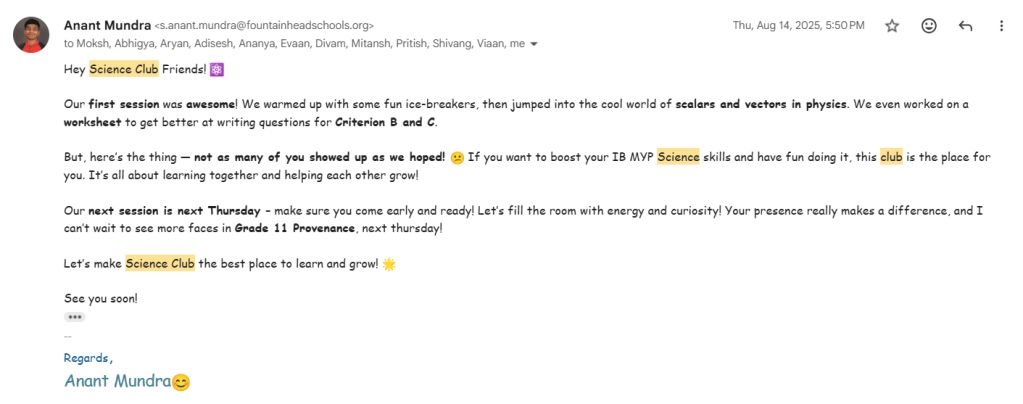
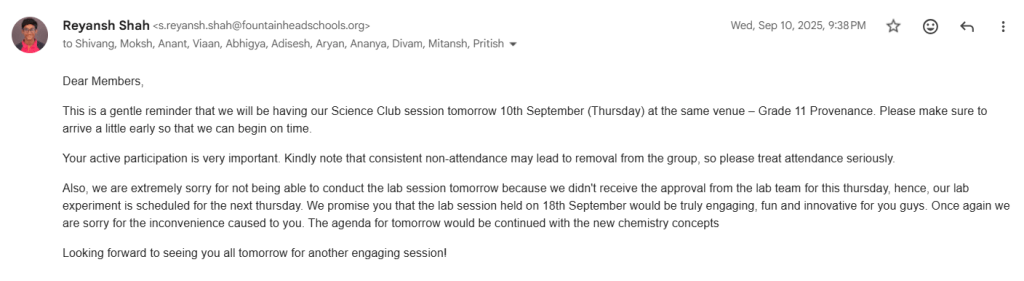
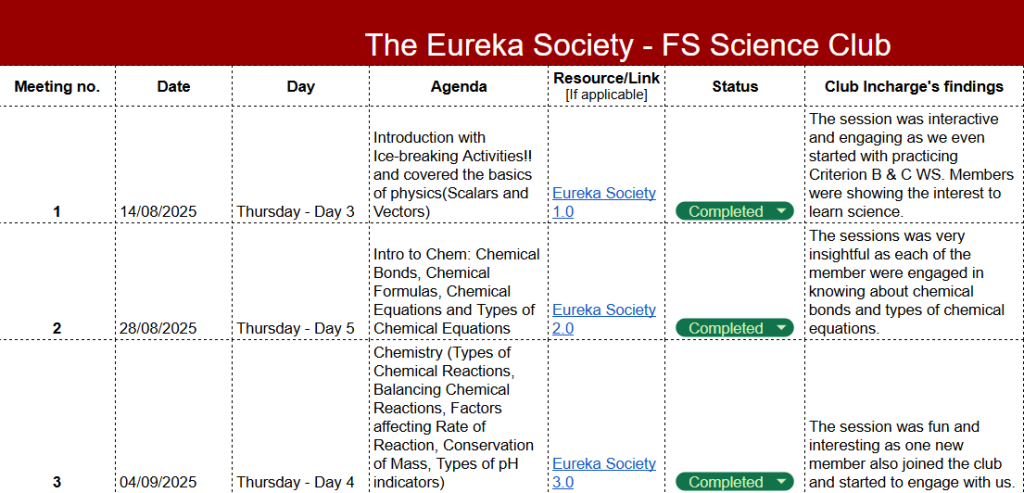
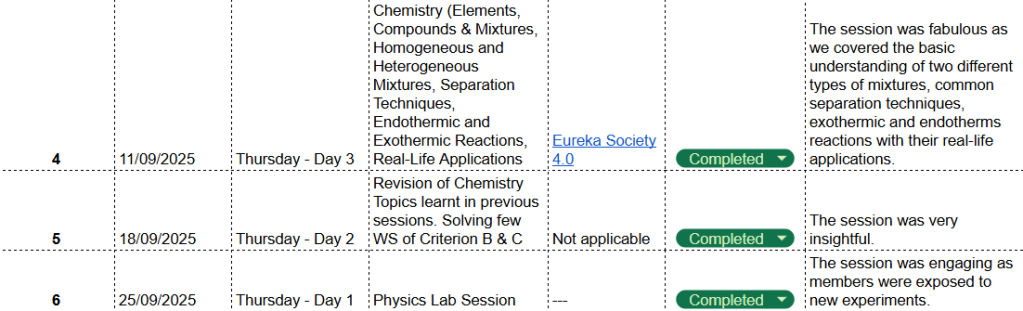
As the Founder of The Eureka Society, FS’s student-led science club, I created a platform to transform how IB MYP students experience science. Our mission was to move beyond memorization and cultivate genuine curiosity, critical thinking, and conceptual understanding. Through interactive labs, simulations, scientific writing, and collaborative problem-solving, the club helped students engage deeply with IB MYP Science Criteria (A–D). Held every Thursday during early ins, each session followed structured monthly themes such as Matter, Cells, Motion, and Energy. The Eureka Society empowered students to explore science actively, build confidence, and develop the skills needed to excel academically and think like scientists.
Learning Outcome 1(LO1): Identify own strengths and develop areas for growth.
Leading The Eureka Society helped me identify my strengths in leadership, organization, and strategic planning. I was responsible for structuring sessions, preparing presentations, and guiding students through experiments. I was confident in making decisions and ensuring smooth execution. However, I also realized that I initially struggled with delegation. I often took on too many responsibilities myself, believing it would ensure success. Through reflection, I learned to trust my co-founder and share responsibilities more effectively. This helped me grow as a leader and develop a more balanced and efficient approach to teamwork.
Learning Outcome 2(LO2): Demonstrate that challenges have been undertaken, developing new skills in the process.
Balancing academics while running the club was one of my greatest challenges. Preparing presentations, designing experiments, and ensuring each session was engaging required strong time management and discipline. Additionally, engaging younger students required patience and adaptability, especially when some students were distracted or less motivated. These challenges helped me develop resilience, communication, and public speaking skills. Over time, I became more confident explaining scientific concepts clearly and managing groups effectively. This experience pushed me beyond my comfort zone and helped me grow both personally and academically.
Learning Outcome 3(LO3): Demonstrate how to initiate and plan a CAS experience
Starting The Eureka Society required significant initiative and planning. My co-founder and I developed a structured framework covering Physics, Chemistry, and Biology to ensure comprehensive learning. We coordinated with teachers, obtained approval, organized schedules, and planned experiments such as outdoor water rocket launches. Initially, it was difficult to predict what activities would engage students the most. Through feedback and reflection, we improved our sessions. This experience taught me how to break large goals into manageable steps and strengthened my confidence in initiating meaningful projects.
Learning Outcome 4(LO4): Show commitment to and perseverance in CAS experiences
There were times when balancing schoolwork and CAS responsibilities felt overwhelming. Despite these challenges, I remained committed to conducting weekly sessions. Students depended on the club, and their curiosity motivated me to continue. Preparing lessons consistently and maintaining regular attendance required perseverance and responsibility. This experience taught me that meaningful impact requires long-term commitment and dedication. I learned to manage my time effectively and remain focused on my goals despite difficulties.
Learning Outcome 5(LO5): Demonstrate the skills and recognize the benefits of working collaboratively
The success of The Eureka Society was not achieved alone. Collaboration with my co-founder allowed us to share responsibilities, exchange ideas, and support each other. Our teamwork improved the quality and effectiveness of our sessions. Collaboration also extended to the students. Their questions and curiosity often led to deeper discussions and enhanced learning for everyone, including myself. This experience taught me that teamwork involves mutual respect, shared responsibility, and valuing diverse perspectives.
Learning Outcome 6(LO6): Demonstrate engagement with issues of global significance
Through teaching scientific concepts such as energy transformations, motion, and chemical reactions, I became more aware of science’s role in addressing global challenges such as climate change and sustainable energy. Helping students understand these concepts contributed to developing scientific awareness and critical thinking. I realized that education plays a crucial role in preparing future generations to solve global problems. This experience strengthened my understanding of the broader importance of science and inspired me to promote scientific curiosity and responsibility.
Learning Outcome 7(LO7): Recognize and consider the ethics of choices and actions
Leading the club required me to act ethically and responsibly. During experiments such as water rocket launches, ensuring student safety was my priority. I also ensured that every student felt included and respected. Providing accurate scientific knowledge was essential because students relied on my guidance. This experience taught me that leadership involves accountability, integrity, and responsibility toward others. I understood that my actions directly influenced students’ learning experiences and attitudes.
Final Reflection: A Transformational Experience
Looking back, founding The Eureka Society was one of the most meaningful experiences of my CAS journey. It helped me develop leadership, communication, collaboration, and ethical responsibility. More importantly, it taught me that leadership is about creating opportunities for others to grow. Seeing students become more confident and curious was the most rewarding outcome.
The Eureka Society was not just a CAS project—it was a journey that transformed me. It showed me that with initiative, perseverance, and passion, I can create meaningful impact and inspire others through education and science.