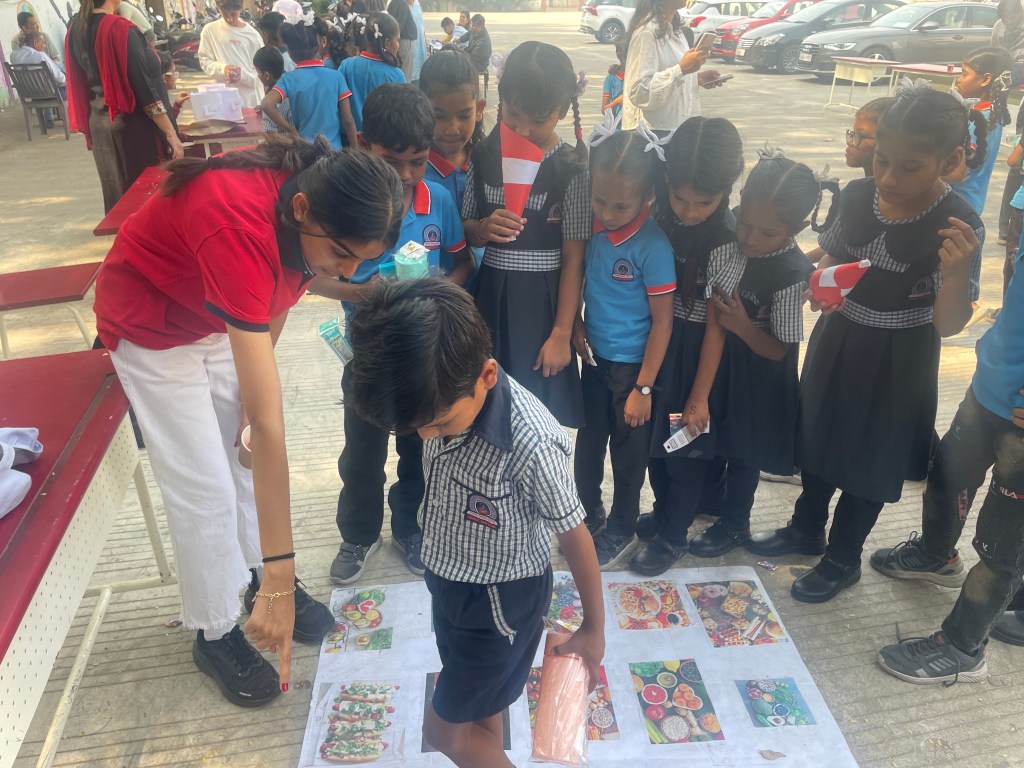
I volunteered at the Children’s Christmas Carnival organised by the Interact Club, where the aim was to make learning feel fun and meaningful for younger students at a government school. The entire space was full of energy, with different stalls offering games and activities. At each stall, children could earn tokens among 20, 30, and 50 points depending on how well they performed, which they further used to buy stationery items. Seeing their excitement as they collected and saved up tokens made the experience even more special. At my stall, I volunteered for a game where children had to identify healthy and unhealthy food items. They were shown a chart and asked to step only on the correct food items within 10 seconds. At first, many of them were a little hesitant, but once they started, they became really enthusiastic, laughing, jumping around, and even helping each other out. When they got the answers right, especially within the time limit, they earned the highest-value tokens, and their faces would light up with pride. That’s what made the whole experience feel so genuine, joyful, and memorable for both them and me.
LO1 – Identify own strengths and develop areas for growth During the Children’s Christmas Carnival, I identified communication as one of my strengths. While managing the stall, I had to explain the activity to students from different age groups, so I adjusted the pace of my communication and the language I used to make sure everyone could understand. For younger students, I used simpler words and explained the rules slowly, while older students understood the instructions more quickly. This helped ensure that all children felt comfortable participating in the activity and understood what they had to do. Through this experience, I became more confident in interacting with different groups of students and guiding them effectively.

LO2 – Demonstrate that challenges have been undertaken, developing new skills
One of the challenges I faced during the activity was managing many students who came to the stall at the same time. It was difficult to keep everyone organised and ensure that each child understood the instructions. To manage this, I separated the students and organised them into a line so they could participate one by one. This helped maintain order and made sure that everyone got a fair chance to take part in the game. Another challenge was keeping the children focused and engaged, as they were very excited and energetic. I often had to repeat the rules and explain them in a fun and simple way so they could understand clearly. Since students arrived at different times, I had to explain the activity again for each new group of children. Through these challenges, I developed skills such as patience, adaptability, and problem-solving while managing and guiding a large group of enthusiastic students.

LO4 – Show perseverance and commitment in CAS experience
During the event, I stayed committed to my role throughout the day, even though the weather was very sunny and hot. Despite the heat and the busy environment, I continued helping students participate in the activity and made sure the stall remained fun and engaging for them. I stayed focused on guiding the children and supporting the event until it ended. This experience showed my perseverance and dedication, as I continued contributing positively even when the conditions were challenging.
LO5 – Demonstrate skills and benefits of working collaboratively
The event was organised by the Interact Club and required strong teamwork to run each stall effectively. I collaborated not only with children from different backgrounds and age groups, but also with fellow volunteers whom I didn’t know very well initially. Despite this, we quickly adapted, communicated clearly, and supported one another throughout the activity. We worked together to guide the children, explain the instructions patiently, and manage the flow of participants so that everyone could take part smoothly.
LO6 – Engagement with issues of global significance
At my stall, I interacted with government school students and guided them through the activity, using it as an opportunity to talk about healthy eating habits. As they played the game, I explained why certain foods were healthier and why some foods should be eaten less often. This helped them think more carefully about the food choices they make in their daily lives. Educating children about nutrition and healthy habits is important globally, as many health problems are linked to poor diet and lack of awareness. Having small conversations like this can have a positive influence, encouraging children to think about their habits and make better choices. Thus, this service allowed me to shape better habits and awareness in young minds that could benefit them in the long run.