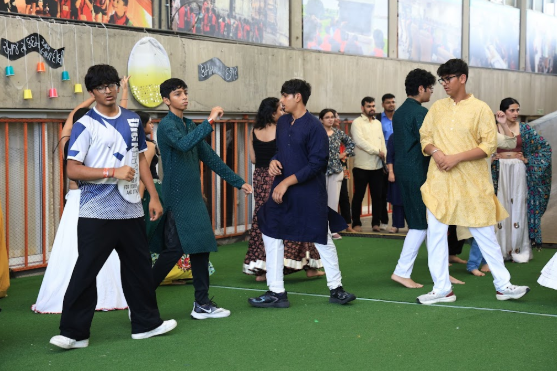

Taking part in the Garba Fest event during the Navratri celebration at my school was an amazing and fun CAS experience. It gave me the opportunity to participate in physical activity, connect with my friends, and see myself in a cultural tradition that celebrates tradition, teamwork, and rhythm. Although I had only learnt a few garba steps and did not know the harder ones, the experience allowed me to identify my strengths, face challenges, develop a new skill, and connect to my traditional practices of navratri. This experience also helped me learn more complex and difficult garba steps which I wouldn’t have learned on my own.
LO1 – Identify own strengths and develop areas for growth
One of the strengths I discovered during the Garba Fest was my confidence. I was not nervous of joining the circle where fast garba was being played even though I was not too smooth with the steps. This demonstrated that I am able to go outside my comfort zone and take part in something that is not part of my daily routine. However, I also observed areas for growth, precisely in my hand and leg movement, endurance, and required stamina to keep up with faster garba circles. Watching other performers do the same steps I was facing difficulty in, I learned the importance of practise and focus, and it motivated me to hone my garba dance skills and my body fitness.
LO2 – Demonstrate that challenges have been undertaken, developing new skills
I did know basic garba but hadn’t played in intermediate circles where speed, coordination, and movement all required attention. The continuous tune, hasty footwork, and circular arrangement meant that I had to stay on my toes and move in sync with the rest of the circle. Through this experience, I developed new skills such as better hand foot coordination, willingness to try new things, and increased stamina. I also became more self confident in terms of gaining new experiences, till now I had played with family where we would dance on a slow easy song, this challenge taught me real garba, like dakla. Participating despite nervousness demonstrated my will power to overcome hurdles and master new skills.
LO5 – Demonstrate skills and benefits of working collaboratively
Garba is a traditional dance that depends completely on collaboration. I had to be aware of the dancers next to me, maintain a suitable distance, and coordinate my pace with the people around me. This required sheer focus, cooperation, and communication to make sure that no one got hurt or uncomfortable. collaboration in this case is crucial because garba is a dance where it is very easy to unintentionally step on someone or push someone, and in fast steps it could really injure someone. Thus I had to understand cues, and actions of my peers to understand where to go slow, where to turn, and thus this dance is a team dance.
LO7 – Recognize and consider the ethics of choices and actions
Participating in the Garba Fest required me to be mindful of cultural respect and ethical behavior. It was crucial to be mindful of my actions as they could affect other people. Like removing shoes before stepping onto the dance floor, this is a basic sign of respect that is expected of anyone before taking part in this traditional festival. This garba fest helped me reflect on how my behaviour had to be ethical and how I had to be aware of my peers’ feelings. Garba is a cultural and religous dance, thus I was very mindful and behaved responsibly.
In a nutshell, this experience taught me of my hidden strengths, areas of improvement, and being ethical. I got to connect to my culture and tradition, given navratri is a cherished festival in my religion. I felt really content after spending an afternoon playing garba with my peers and becoming better at it. Additionally, this experience helped me learn about the necessity of being physically fit and having a good endurance.