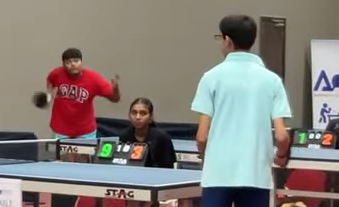
During my CAS exploration in Activity for the IBDP, my journey with table tennis became one of the most meaningful and transformative experiences of the year. What began as a casual interest gradually evolved into a disciplined commitment as I prepared for the ISSO competition, pushing myself to refine not only my technical skills but also my mental resilience. The p rocess required consistent practice, strategic planning, and honest self-reflection—every training session revealed new strengths and exposed weaknesses that I needed to address. Participating in the ISSO competition was a defining moment, as being surrounded by athletes from various schools challenged me to perform under pressure while maintaining sportsmanship and confidence. The intensity of the matches taught me to stay composed, adapt quickly, and trust the preparation I had invested in. Beyond the physical aspect, the experience significantly strengthened my perseverance, teamwork, and time-management skills, as balancing academics with training required careful organization. Ultimately, this exploration allowed me to grow holistically—not just as a player, but as a learner who values dedication, humility, and continuous improvement.
LO 1: Identify own strengths and develop areas for growth Screen reader support enabled
This table tennis experience clearly highlighted my strengths in discipline and perseverance, demonstrated by the shift from casual interest to disciplined commitment and the consistent effort required for competition preparation. My resilience and ability to perform under pressure were also key strengths, evident during the intense ISSO matches where I maintained composure and adapted quickly.
LO 2: Demonstrate that challenges have been undertaken, developing new skills.
The commitment to table tennis was defined by the challenges undertaken, transforming a casual pursuit into a rigorous, competitive journey. Preparing for the ISSO competition demanded the development of entirely new technical and strategic skills, such as mastering the short push service and executing rapid counter-attacks, which were initially outside my comfort zone. The greatest challenge, however, lay in cultivating mental resilience; learning to manage the pressure of high-stakes matches and adapt quickly to shifting opponent strategies were skills acquired directly under duress. This demanding process not only refined my physical abilities but fundamentally enhanced my time-management and self-reflection capabilities, demonstrating a commitment to growth driven by facing and overcoming genuine adversity.
LO 4: Show perseverance and commitment in CAS experience.
The journey to the ISSO competition serves as a direct demonstration of both commitment and perseverance. My commitment was shown by the conscious choice to move beyond casual interest to establish a rigorous, disciplined routine, including consistent practice and strategic planning—a decision that required prioritizing training over free time. This commitment extended to time-management, where I meticulously organized my schedule to successfully balance the demands of intense training with academics. Perseverance was necessary to navigate the inevitable plateaus and setbacks; every training session involved honest self-reflection and the sustained effort required to address exposed weaknesses. Ultimately, the pressure of the ISSO competition demanded the highest level of perseverance, requiring me to stay composed, adapt quickly, and rely completely on the months of persistent preparation invested, underscoring a deep resolve to achieve my goal.
LO5 – Demonstrate skills and benefits of working collaboratively.
Participating in the ISSO competition’s team event was the primary way I demonstrated the benefits of working collaboratively. Table tennis, often viewed as an individual sport, requires a distinct form of teamwork in a team format. My initial challenge was moving from focusing solely on my personal game to understanding my role as a supportive component of the larger team strategy. This meant actively communicating with my partner and coach to design a collective game plan, which involved identifying our opponents’ weaknesses and setting the optimal player order. During the matches, effective collaboration was crucial for maintaining momentum; we relied on continuous, non-verbal signals and supportive encouragement to stay focused. This experience developed my skills in team strategy formulation and taught me the value of shared success and collective resilience, proving that synergy and mutual trust are as vital in competitive sport as individual technique.
Ultimately, my table tennis exploration was a comprehensive demonstration of holistic growth, transforming a simple interest into a powerful lesson in dedication. The process required immense perseverance and commitment to move past early challenges and consistently address technical weaknesses. By confronting the pressure of the ISSO competition, I developed crucial new skills in mental resilience and effective time-management. Furthermore, the team event underscored the essential benefits of working collaboratively, refining my communication and strategic support skills. This journey reinforced the value of humility, consistent self-reflection, and the understanding that continuous improvement is achieved through disciplined, committed action.
