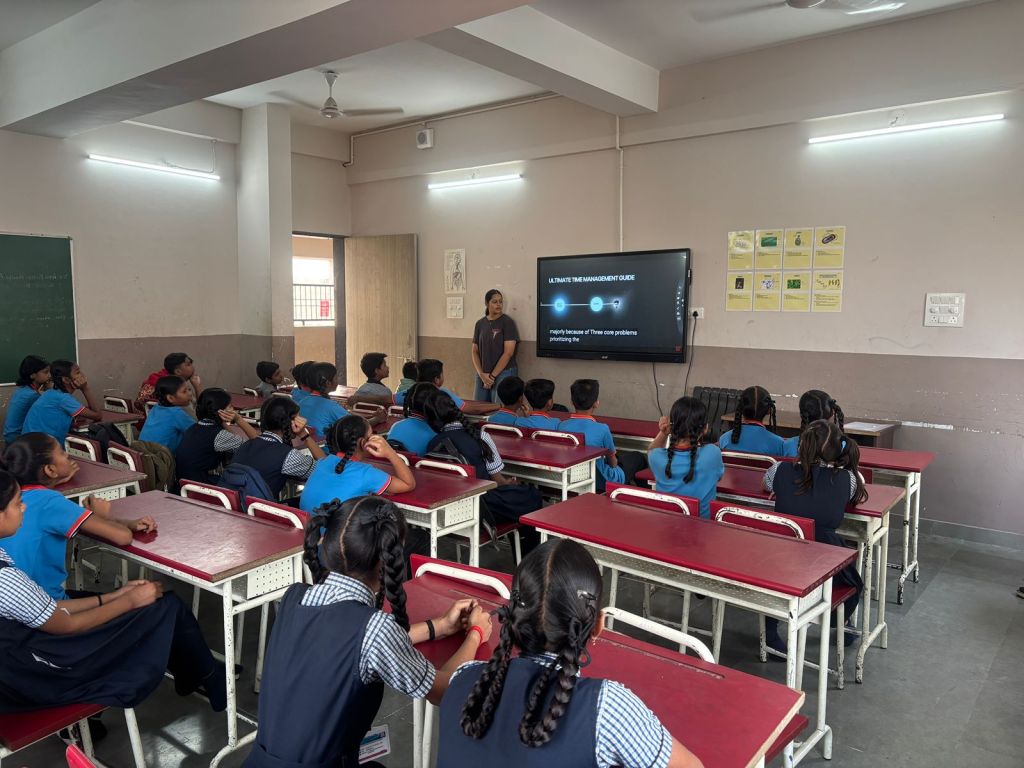
Teaching young kids at a local government school
For my CAS Service project, I had the privilege of visiting a local government school over three Saturdays to conduct workshops on Time Management and Memory. We wanted to move beyond the traditional “boring” lecture style, so we developed a curriculum focused on “Meta-Learning” which is teaching the kids how their own brains work. We covered everything from how to move information into long-term memory to why discipline beats motivation every time. By using interactive worksheets and high-energy games, we were able to turn a potentially dry subject into a vibrant, engaging learning experience for both the students and ourselves.
Learning Outcomes Catered
LO1 – Knowing strengths and areas to improve: I found that I am very good at simplifying complex psychological concepts like short-term memory into fun metaphors. However, I realized I need to improve my classroom management, as it was difficult to regain the kids’ attention once they got excited during the activities.
LO2 – Facing challenges and learning new skills: The main challenge was ensuring the sessions weren’t boring and monotonous. I learned the skill of pedagogical design by creating worksheets and interactive games that kept the students engaged while still ensuring they walked away with a real understanding of discipline.
LO3 – Planning and taking initiative: I initiated the three-week syllabus, planning exactly how to transition from theory to fun activities. I learned that proper planning of worksheets is vital because it gives the students a tangible takeaway to practice their new time-management skills at home.
LO4 – Commitment and perseverance: Spending three consecutive Saturdays teaching was a significant commitment. Even when I felt tired from my school week, seeing the kids’ enthusiasm kept me motivated to deliver each session with high energy and dedication.
LO5 – Working with others: I worked closely with my peers to ensure the sessions ran smoothly. We had to trust each other to handle different groups of kids during the fun activity segments, which taught me the importance of clear communication in a teaching environment.
LO6 – Global importance: Quality education (SDG 4) is a global goal. By teaching skills like memory techniques and time management to kids who might not otherwise have access to them, I realized how education can be a tool to reduce social inequalities on a larger scale.
LO7 – Making ethical choices: I had to make ethical choices about how to present the concept of discipline. I chose to frame it as a tool for personal freedom and success rather than a strict set of rules, ensuring I was empowering the students in a positive and responsible way.
Final Takeaway
The final takeaway from these three Saturdays was that teaching is the best way to truly learn. Seeing a child’s eyes light up when they understood a memory trick or seeing them proudly complete a time-management worksheet was incredibly rewarding. It gave me a satisfactory feeling of giving back to society in a meaningful, fun way. I realized that education isn’t just about what is in the textbooks but it’s also about the confidence and discipline we build in ourselves. I’ve come away from this experience with a much deeper appreciation for my own education and a commitment to continue mentoring others whenever the opportunity arises.