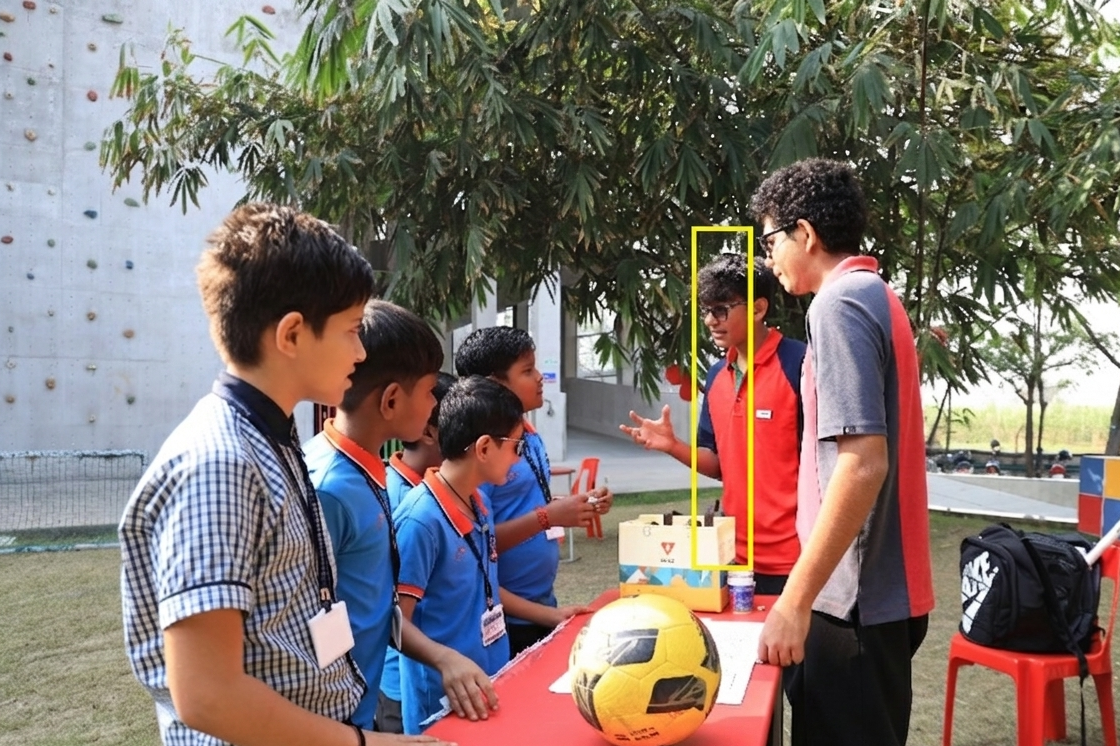
Introduction: At the Children’s Carnival, my friend and I organized a stall aimed at teaching financial literacy to children from government schools, with a focus on understanding the difference between needs and wants. We designed an engaging game where each child selected a random chit containing a question. If they answered correctly, they were given three attempts to score a goal from a set distance. Depending on the difficulty of the question, they could earn 10, 20, or 50 points. This combination of education and sport helped maintain their interest while reinforcing key concepts effectively.
LO1 – Identify own strengths and develop areas for growth: Throughout the activity, I recognized that one of my strengths is simplifying concepts so that younger children can easily understand them. I was able to explain the rules clearly and help them feel at ease. However, I also realized that I need to improve my management skills, particularly when handling large groups. This experience highlighted areas where I can grow as a communicator and become more effective in teaching roles.
LO2 – Demonstrate that challenges have been undertaken, developing new skills in the process: One of the main challenges was managing a large number of children at the same time, all eager to participate. This required quick decision-making, clear communication, and constant supervision. Another difficulty was ensuring that children truly understood their questions rather than guessing answers. Through these challenges, I developed stronger leadership abilities, improved my communication skills, and learned to multitask efficiently. I also adapted my explanations based on the age and understanding of each child.
LO3 – Demonstrate how to initiate and plan a CAS experience: We developed the entire activity independently. This included creating the rules, preparing the chits, deciding difficulty levels, and organizing the goal-scoring setup. We divided responsibilities, with me managing the questions and my friend overseeing the football activity. This process taught me how to plan systematically, organize resources, and ensure smooth execution during the event.
LO4 – Show commitment to and perseverance in CAS experiences: The event continued for several hours, during which we remained actively involved throughout. Despite feeling tired or facing busy moments at the stall, we continued assisting and teaching the children. I remained dedicated because I wanted every child to benefit from the experience. This showed me that meaningful service requires sustained effort and commitment.
LO5 – Demonstrate the skills and recognize the benefits of working collaboratively: Our teamwork played a key role in the success of the stall. Responsibilities were clearly divided—some managed questions, others supervised the football activity, and a few kept track of scores. Continuous communication ensured everything ran efficiently. This experience reinforced the importance of collaboration, as it allows tasks to be handled more effectively and creates a better overall experience.
LO6 – Demonstrate engagement with issues of global significance: Financial literacy is an important global concern, as many young individuals lack basic knowledge about managing money. By introducing the concepts of needs and wants, we contributed to building awareness and responsible thinking among the children. Although our effort was small, it addressed a broader issue of providing essential life skills that can positively impact future decision-making.
LO7 – Recognize and consider the ethics of choices and actions: During the planning and execution of the activity, we ensured that everything was conducted fairly and respectfully. All children were treated equally, regardless of their performance. We maintained a safe environment and ensured honesty in scoring. Our aim was to educate in a supportive way, without making anyone feel uncomfortable or pressured. Upholding these values helped create a positive learning atmosphere.
Conclusion: The Children’s Carnival was a rewarding service experience that allowed us to teach valuable life skills in an enjoyable and interactive manner. I gained a deeper understanding of my strengths, improved my teamwork and leadership skills, and learned the importance of patience, fairness, and responsibility. This experience demonstrated how even small initiatives can create meaningful impact when approached with dedication and purpose.