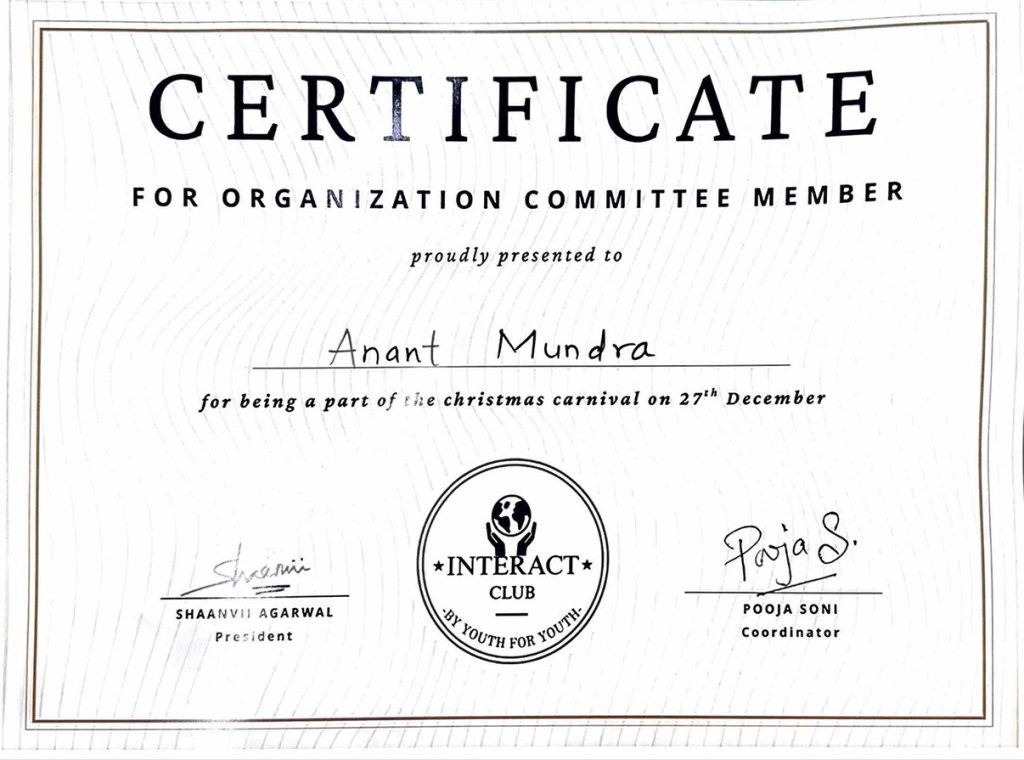
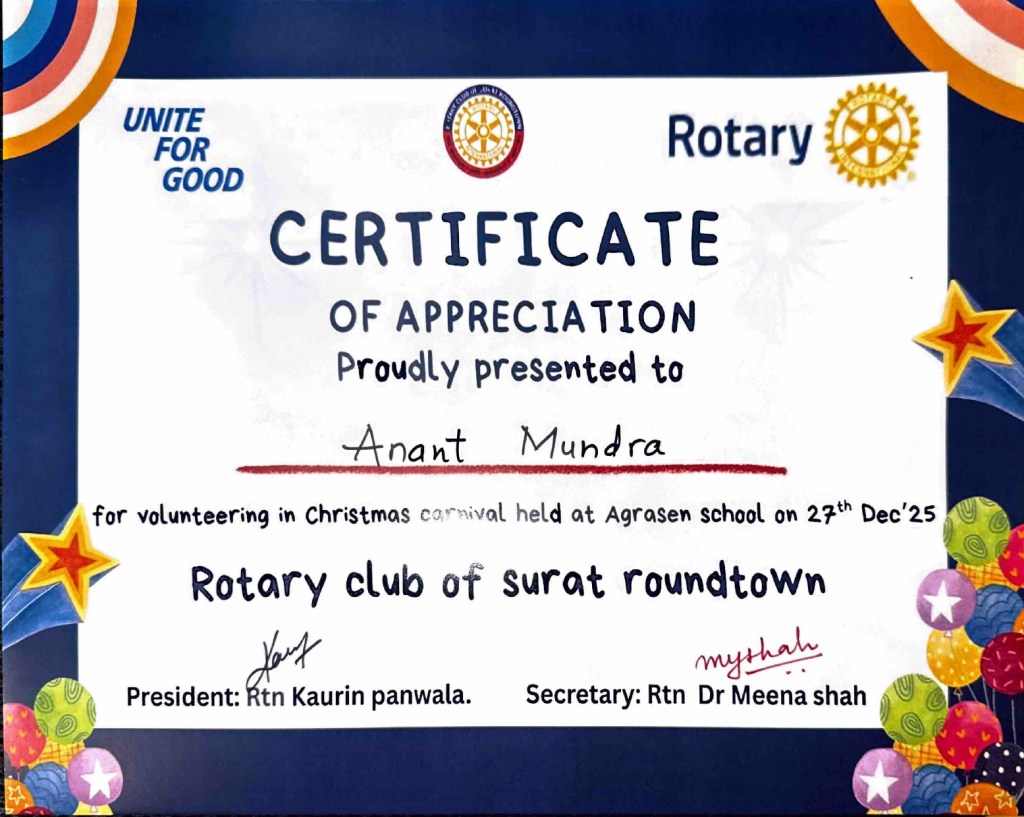
The Children’s Christmas Literacy Carnival was not just an event — it was a space built around play, design, and experience-based learning. Organised by the Interact Club in collaboration with Rotary Downtown, the carnival brought together around 700 government school students at Agrasen School, Citylight, and transformed learning into something interactive, intuitive, and engaging rather than instructional.
Instead of formal teaching, the carnival used games, systems, and participation to help children learn through experience. Every stall, rule, and interaction was part of a larger design that shaped how students moved, played, made choices, and understood value.

Experience Description
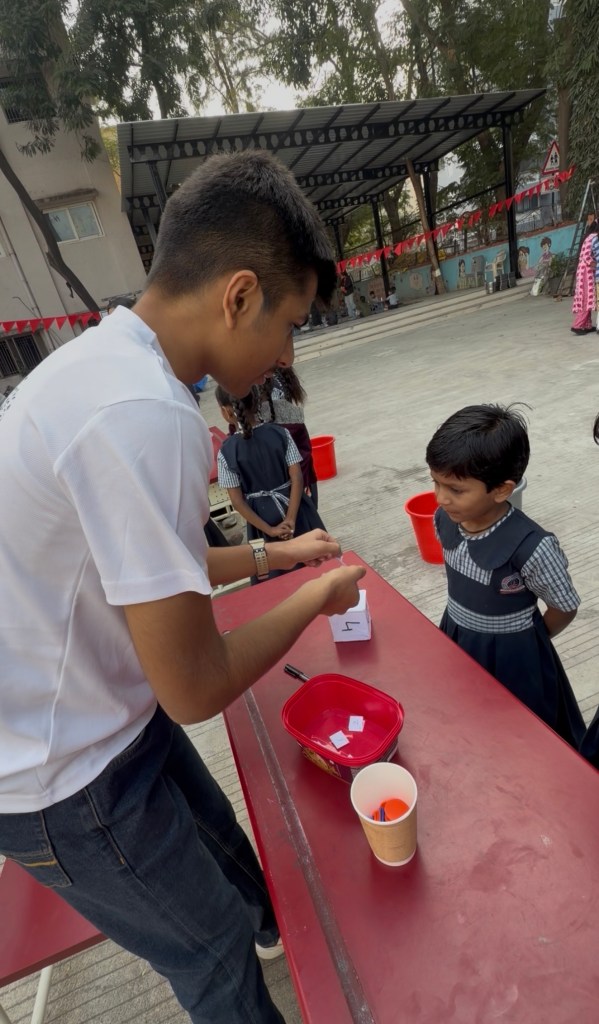
My role in the carnival was centred around creating engagement. At my stall, I wasn’t just supervising a game — I was shaping how children experienced it. I explained rules, adjusted the way the game worked for different age groups, changed the flow when confusion arose, and made sure the activity stayed fun, fair, and understandable for everyone. This required constant creativity, because no two groups of students responded in the same way.
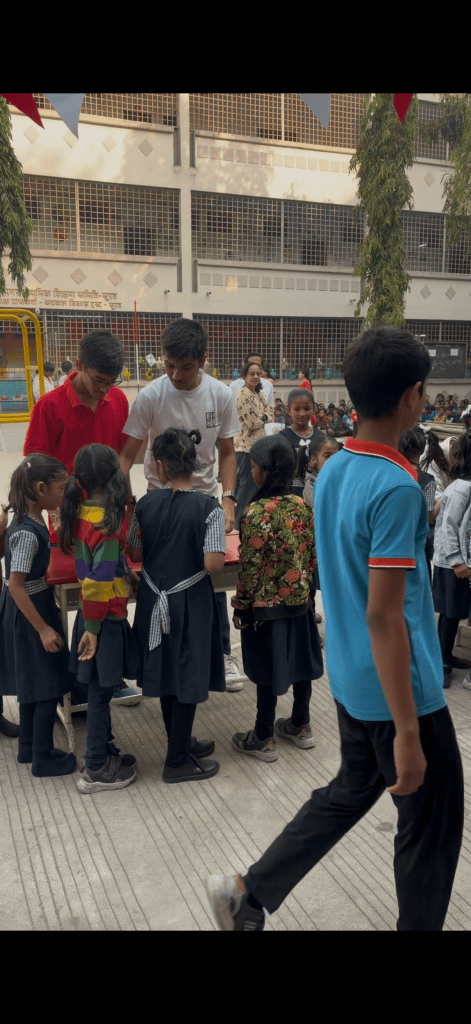
As the event progressed, I became more involved in the overall structure of the carnival. I helped manage how students moved between stalls, supported the flow of activities during crowded periods, and stepped in wherever systems began to break down. This meant adapting processes on the spot — changing how lines were managed, how games were run, and how students were guided through the space. Most of this work wasn’t planned in advance — it was creative problem-solving in real time.
The token system was one of the most interesting parts of the carnival. It wasn’t just about rewards, it shaped behaviour. Children learned that participation, effort, and fairness led to earning tokens, and that tokens could be exchanged for meaningful items. Watching how students made choices, saved tokens, or immediately spent them showed how simple design structures can teach responsibility and decision-making without anyone having to formally “teach” it.
What stood out most was how learning happened naturally. Children from different language backgrounds, age groups, and schools were all able to participate equally because the system didn’t rely on heavy instruction- it relied on experience, interaction, and play. The design of the carnival itself became the teacher.
CAS Learning Outcomes Demonstrated
LO1 – Identifying strengths and areas for growth
This experience helped me clearly recognise my personal strengths in adaptability, communication, and situational awareness. Working in an unpredictable environment with large groups of children showed me that I am comfortable taking responsibility, adjusting quickly, and staying composed under pressure. I learned that I am naturally responsive rather than rigid, and that I can handle dynamic situations without losing focus.
At the same time, the carnival revealed areas where I need growth. I realised that I often rely on improvisation instead of structure. While adapting in the moment worked well, I became aware that stronger planning and pre-structuring would make systems more efficient and reduce confusion. This helped me understand the difference between reacting well and designing well — and showed me the importance of developing both.
LO2 – Undertaking challenges and developing new skills
The scale and pace of the carnival created constant challenges. Managing large groups of children, maintaining engagement, handling confusion, and responding to crowd pressure required continuous adjustment. There were no fixed solutions, every situation demanded a different response.
Through this, I developed new skills in real-time problem-solving, engagement design, crowd flow management, and behavioural handling. I learned how to read situations quickly, respond calmly, and make practical decisions that improved the experience for others. These were not technical skills learned in theory — they were lived skills built through direct experience.
LO3 – Initiating and planning
This experience deepened my understanding of how planning shapes human experience. I began to see how rules, systems, and structures influence behaviour, learning, and participation. Even small design choices — such as how rules are explained, how movement is guided, or how rewards are structured — have a major impact on how people engage.
I learned that creativity is not just about ideas, but about intentional structure. This shifted my thinking from simply participating in activities to understanding how experiences are designed and shaped. It helped me grow from being a participant to becoming someone who thinks about systems, flow, and structure.
LO5 – Working collaboratively
The carnival made it clear that no creative system functions in isolation. Smooth operation depended on cooperation, trust, and shared responsibility between volunteers, organisers, and students. Everyone played a role in maintaining flow, structure, and fairness.
I learned how collaboration is not just about working together, but about supporting each other’s roles, stepping in when needed, and maintaining stability under pressure. This experience strengthened my understanding of teamwork as a living process, not just a formal arrangement of roles.
LO6 – Engagement with issues of global significance
This experience connected directly to the global idea of inclusive and accessible education. The carnival showed how learning can be designed in ways that do not depend on language, background, or formal instruction. By using games and experience instead of traditional teaching, it created a learning space where every child could participate equally.
This helped me understand how creative systems can support global educational goals by making learning human, intuitive, and inclusive rather than rigid and exclusive.
LO7 – Recognising and considering the ethics of choices and actions
Ethics were embedded in every part of the experience. Fair rule enforcement, equal access to participation, respectful treatment of students, and honest token distribution were not small details — they shaped trust and safety within the environment.
I learned that creative design carries responsibility. Systems influence behaviour, and if they are not run ethically, they can easily become unfair or harmful. This experience taught me that creativity must always be guided by integrity, fairness, and accountability, especially when working with children and vulnerable communities.
Reflection
This experience reshaped my understanding of creativity. It demonstrated that creativity is not limited to artistic production, but exists in systems, structures, design, and experiential architecture. Designing engagement, structuring learning environments, and shaping behaviour through interaction revealed creativity as a form of applied intelligence.
The Christmas Literacy Carnival showed me how well-designed systems can produce learning naturally, without formal instruction. It strengthened my appreciation for experiential learning design, collaborative creation, and ethical system-building, and helped me understand how creativity operates at the level of structure, not just expression.
This was not simply participation — it was creative involvement in building an environment where learning, engagement, and experience were shaped through design.