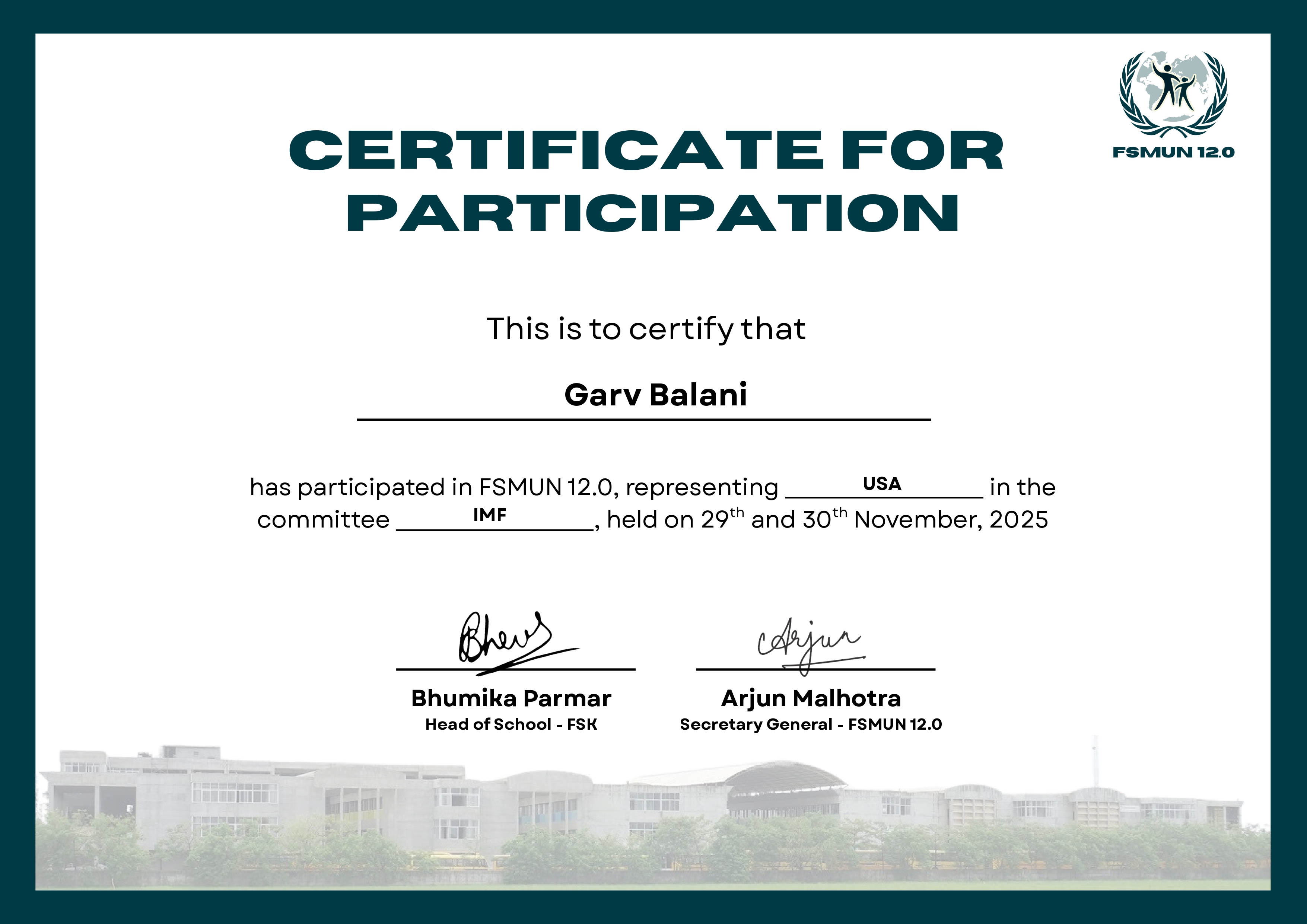
FSMUN (Fountainhead School Model United Nations) was a valuable CAS experience where I participated as a delegate representing the United States in the International Monetary Fund (IMF) committee. The committee focused on the geopolitical impacts of rapid foreign infrastructural projects in Africa. As part of the Creativity strand, I researched the United States’ position, participated in formal debates and negotiations, and worked with other delegates to develop solutions to the issue. The experience challenged me to think critically about complex international issues while developing my communication, negotiation, and collaboration skills.
LO1 – Identify own strengths and develop areas for growth
FSMUN helped me recognise that public speaking and expressing ideas confidently are some of my strengths. However, I also realised that effective debate requires more than simply presenting my own arguments. I needed to listen carefully to other delegates, understand their perspectives, and adapt my responses accordingly. This helped me develop greater flexibility in my thinking and improve my ability to respond to arguments under pressure.
LO2 – Demonstrate that challenges have been undertaken, developing new skills
Representing a country in the IMF required me to step outside my usual academic environment and defend positions that were not necessarily my own. I had to research economic and geopolitical issues, formulate arguments, speak in formal debates, and negotiate with other delegates. These unfamiliar responsibilities challenged me to develop my public speaking, research, negotiation, and critical thinking skills.
LO4 – Show perseverance and commitment in CAS experience
Preparing for FSMUN required significant commitment before the conference itself. I researched the United States’ policies and the economic and geopolitical implications of foreign infrastructure projects in Africa so that I could participate meaningfully in committee discussions. During the conference, I remained engaged through multiple rounds of debate and negotiation, even when discussions became challenging or my proposals were questioned. This taught me the importance of preparation and perseverance when working towards a goal.
LO5 – Demonstrate the skills and benefits of working collaboratively
Collaboration was central to the MUN experience. Although each delegate represented an individual country, reaching meaningful solutions required us to negotiate, form alliances, compromise, and work together on proposed resolutions. I learned that defending my country’s interests did not mean rejecting other perspectives, but rather finding areas of common ground. Working with other delegates strengthened my communication and negotiation skills and showed me the value of compromise.
LO6 – Engagement with issues of global significance
The IMF committee addressed the geopolitical and economic impacts of rapid foreign infrastructural projects in Africa, an issue involving international investment, economic development, sovereignty, and global cooperation. Through the debate, I gained a deeper understanding of how infrastructure projects can have consequences beyond economic growth and can influence relationships between countries. The experience connected strongly with SDG 9: Industry, Innovation and Infrastructure, while also highlighting the importance of international cooperation and sustainable development.
LO7 – Recognise and consider the ethics of choices and actions
The committee required me to consider the consequences of foreign investment and infrastructure development on African countries. While such projects can support economic development, they can also raise questions about dependency, national sovereignty, unequal bargaining power, and the interests of foreign investors. Representing the United States required me to consider these competing interests rather than viewing the issue from only one perspective. This helped me understand that international economic decisions can have significant consequences for different groups of people and countries.
Overall, FSMUN strengthened my confidence in public speaking while developing my research, negotiation, critical thinking, and collaboration skills. More importantly, it exposed me to the complexity of international economic decision-making and taught me that effective diplomacy requires both strong advocacy and a willingness to listen, compromise, and consider different perspectives.