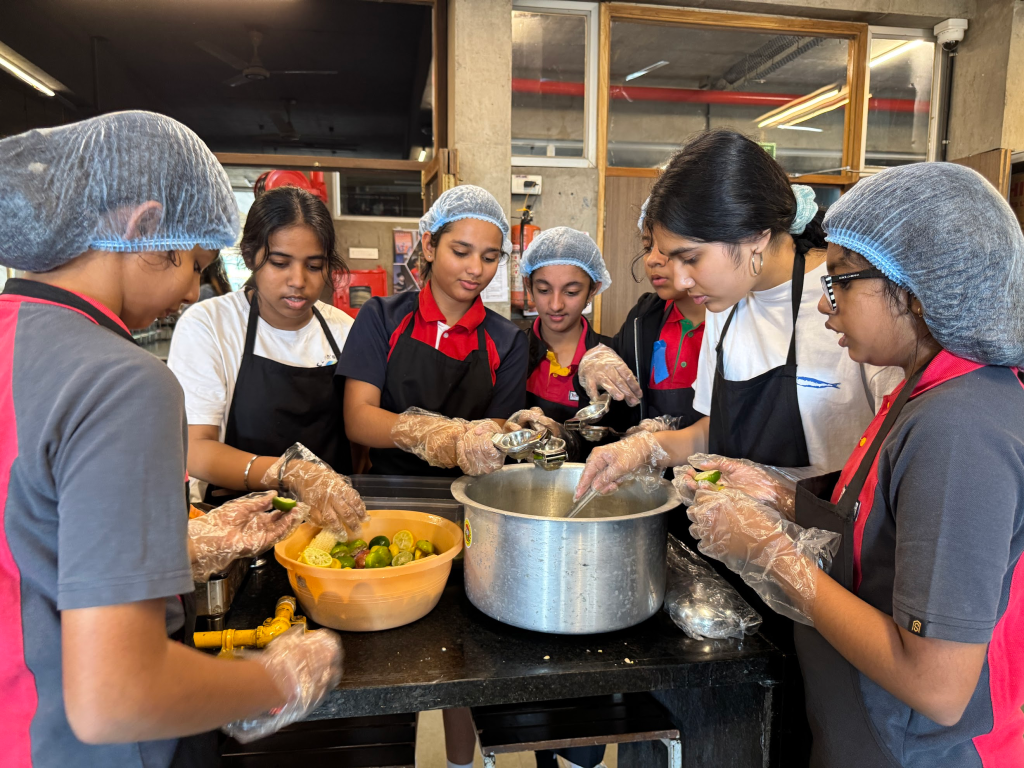
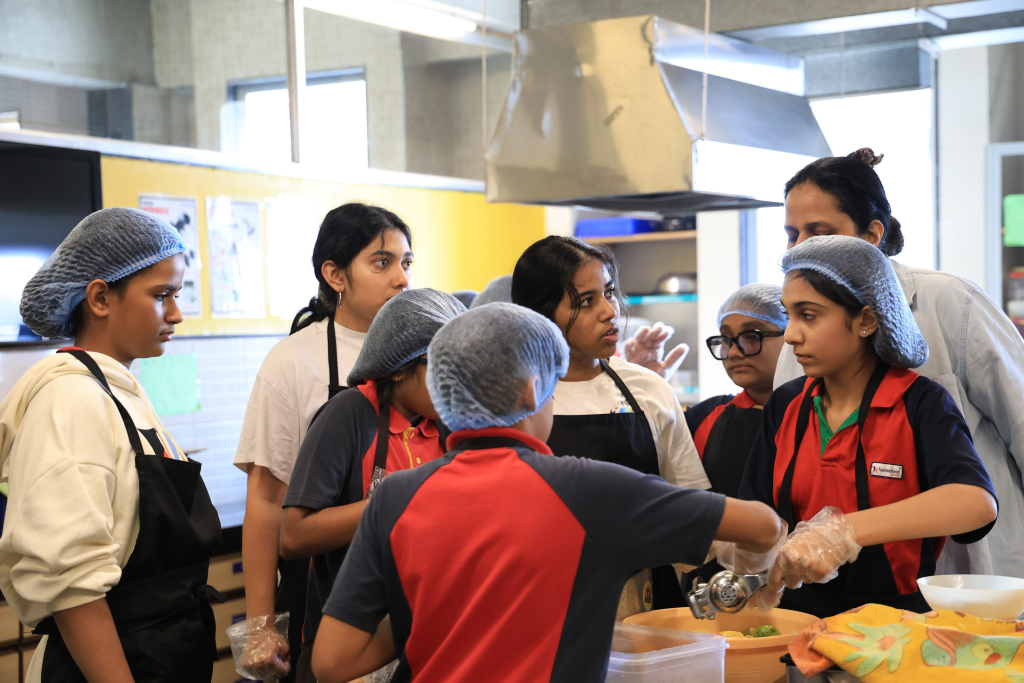
As a member of Earth’s 911 and the Events Head, I was actively involved in planning and executing Groove for Good 3.0, the organization’s annual experiential learning initiative. The event was designed to introduce Grade 6 students to important social and environmental issues through hands-on, interactive workshops, while also serving as a Tuning In activity for their PYP Exhibition. Groove for Good 3.0 brought together Grade 6 students, government school participants, and volunteers to engage in meaningful learning experiences that encouraged awareness, empathy, and action.
Within this initiative, I specifically overlooked and coordinated the Healthy Cooking and Donation workshop, which focused on home science and essential life skills. During this workshop, students prepared biryani and lemonade, learning about nutrition, hygiene, teamwork, and basic cooking techniques. The food prepared was then served to government school children, allowing students to directly connect learning with service. This experience helped translate theoretical understanding into real-world impact and highlighted the importance of responsibility, empathy, and community engagement.
Learning Outcome 1 – Identify own strengths and develop areas for growth
Through this experience, I recognized my strengths in organization, communication, and event coordination. As the Events Head for this workshop, I planned the session structure, organized ingredients and materials, and guided volunteers on task distribution to ensure the cooking process ran smoothly and safely. I was also responsible for explaining the purpose of the workshop to participants, helping them understand how cooking relates to daily life skills and social responsibility.
However, I identified an area for growth in delegation. Initially, I tried to supervise every aspect of the workshop myself, from preparation to serving, which was overwhelming. Over time, I learned to delegate responsibilities such as ingredient preparation, cooking supervision, and serving, which improved efficiency and allowed me to focus on overall coordination. This experience taught me the importance of trusting others and working collaboratively.
Learning Outcome 2 – Demonstrate that challenges have been undertaken, developing new skills
Managing a live cooking workshop came with several challenges, including time constraints, safety concerns, and coordinating multiple students and volunteers simultaneously. There were moments when tasks took longer than expected or required quick adjustments to stay on schedule. I learned to stay calm, think quickly, and modify the workflow to ensure the session remained organized and productive.
Through this process, I developed new skills in problem-solving, adaptability, teamwork, and basic workshop facilitation. I also strengthened IB ATL skills such as self-management (organizing tasks efficiently), social skills(communicating clearly with volunteers and students), and thinking skills (adjusting plans when needed). These challenges helped me grow more confident in handling responsibility during dynamic situations.
Learning Outcome 3 – Initiate and plan a CAS experience
The Healthy Cooking workshop required careful planning and initiative. I helped design the session to include both learning and service, ensuring that students not only cooked but also understood the importance of nutrition and giving back. I planned the activity flow, coordinated ingredients and equipment, and worked with volunteers to ensure safety and hygiene standards were followed.
I also prepared backup plans in case of shortages or delays and spent time before the event coordinating logistics. This planning process strengthened my organizational and leadership skills and gave me practical experience in executing a structured CAS activity with clear objectives and outcomes.
Learning Outcome 4 – Show perseverance and commitment in CAS experience
Executing the workshop required sustained commitment, especially while balancing schoolwork and other responsibilities. Preparation involved multiple stages, including planning, coordination, and execution on the day of the event. Despite challenges such as time pressure and last-minute adjustments, I remained committed to ensuring the workshop was successful.
Seeing the food being shared with government school students made the effort worthwhile and reinforced my motivation to persevere. This experience taught me the value of dedication and consistency in service-based initiatives.
Learning Outcome 5 – Demonstrate skills and benefits of working collaboratively
Collaboration was essential to the success of the workshop. I worked closely with volunteers and peers, assigning tasks based on individual strengths, such as cooking assistance, ingredient handling, and serving. Clear communication and teamwork ensured that the workshop ran smoothly and safely.
This experience showed me that working collaboratively enhances efficiency and impact. By supporting one another, we were able to create a meaningful and well-organized learning experience for both participants and beneficiaries.
Learning Outcome 6 – Engagement with issues of global significance
The Healthy Cooking and Donation workshop addressed global issues related to SDG 2: Zero Hunger, SDG 3: Good Health and Well-being, and SDG 12: Responsible Consumption and Production. By preparing nutritious food and donating it to government school students, participants learned about balanced diets, food responsibility, and social equity.
This experience helped me understand how small, local actions — such as cooking and sharing food — can contribute to broader global goals. It highlighted the importance of life skills and compassion in addressing social inequalities.
Learning Outcome 7 – Recognize and consider the ethics of choices and actions
Ethical considerations were central to this workshop. I ensured that hygiene, safety, and respect were prioritized throughout the activity. Students and volunteers were guided to work responsibly, and the food was prepared with care and sensitivity for those who would receive it. I also ensured fair task distribution among volunteers and maintained transparency in resource usage. This experience reinforced my understanding that ethical leadership involves responsibility, empathy, and respect for all individuals involved.
Conclusion
Being the Events Head for the Healthy Cooking workshop at Groove for Good 3.0 was a meaningful and enriching part of my CAS journey. This experience allowed me to develop leadership, planning, and collaboration skills while understanding the importance of life skills and service. Watching students apply what they learned and seeing the impact of their efforts on others reinforced my belief that experiential learning can create real change. This initiative showed me that CAS is not just about participation, but about reflection, responsibility, and making a positive difference in the community.